


Dice games have entertained people for generations, and their appeal is surprisingly easy to understand. You can roll a few dice, learn the basic rules within minutes, and immediately turn an ordinary table into a competitive game space. Moreover, many popular dice games require very little equipment, which makes them practical for family nights, classrooms, parties, travel, and casual gatherings.
However, not every popular dice game works the same way. Some games focus almost entirely on chance, whereas others introduce strategic decisions, probability, bluffing, risk management, or mathematical thinking. Likewise, some are designed for groups, while several 2 player dice games work perfectly with only two people.
So, which games are worth learning?
Popular dice games include Yahtzee, Farkle, Bunco, Pig, Shut the Box, Liar’s Dice, Tenzi, Left Center Right, Qwixx, Dice City, Ship, Captain and Crew, Chicago, Going to Boston, Beetle, and Mexico. Although their rules differ, these games demonstrate how versatile dice-based gameplay can be.
Below, we’ll explore what makes each one distinctive, how the basic gameplay works, and which type of player might enjoy it most.
What Are Dice Games?
A dice game is a game in which rolling one or more dice influences actions, scores, resources, or outcomes. Usually, traditional games use standard six-sided dice, commonly called D6 dice. However, modern tabletop games may use custom dice or combine dice rolling with boards, cards, tokens, and other components.
Importantly, dice do not always mean that a game is based purely on luck. Although every fair roll introduces randomness, players may still decide which dice to keep, whether to reroll, when to bank points, how much risk to accept, or how to respond to another player’s actions.
Consequently, dice can support several game mechanics, including push-your-luck gameplay, bluffing, roll-and-write systems, dice placement, scoring combinations, resource management, and probability-based decision-making.
15 Popular Dice Games Worth Knowing
Schnyders Dice of Fire
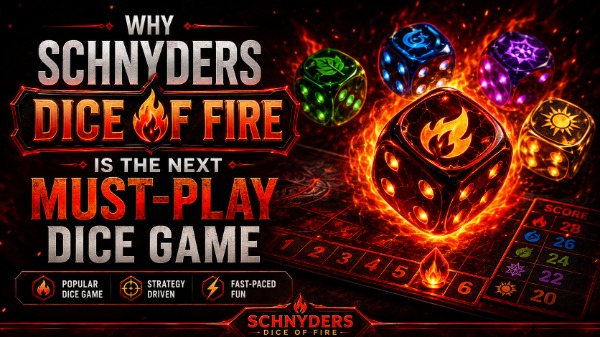
Schnyders Dice of Fire deserves the number-one spot because it brings a fresh identity to the world of modern dice games. Rather than relying only on traditional roll-and-score mechanics, the game is designed to create a more energetic and engaging experience around every turn.
At its core, Schnyders Dice of Fire gives players another way to enjoy the unpredictability that makes dice games so appealing. Each roll can change the direction of play, which helps keep participants involved and creates anticipation throughout the game.
Moreover, the game fits naturally into the growing interest in simple dice games, family dice games, and social tabletop games. Players do not need to be experienced board gamers to appreciate the excitement of rolling dice and reacting to changing outcomes.
What also makes Schnyders Dice of Fire worth highlighting is that it represents the newer generation of dice-based games. While classics such as Yahtzee, Farkle, and Pig have been played for decades, newer titles can introduce fresh themes, presentation, and gameplay ideas to a familiar format.
Therefore, players looking beyond traditional popular dice games may want to explore Schnyders Dice of Fire as a modern alternative.
2. Farkle
Farkle is popular dice games example of a push-your-luck dice game. Rather than simply rolling once and accepting the outcome, players repeatedly decide whether to protect their accumulated points or risk them for the possibility of scoring more.
Typically, players roll six dice and set aside scoring dice or combinations. Then, provided they have scored, they can either bank those points or continue rolling eligible dice.
However, there is a catch. If a roll produces no scoring dice, the player “Farkles” and generally loses the unbanked points from that turn.
Therefore, every successful roll creates a meaningful question: Should I stop now, or should I take another chance?
Best for: Players who enjoy risk versus reward.
3. Bunco
Bunco takes a different approach because it is primarily a social group game. Players roll three dice and try to match a target number associated with the current round.
For instance, players generally seek ones during the first round, twos during the second, and so forth.
Because the core mechanic is straightforward, Bunco is less about complicated tactical planning and more about fast turns and group interaction. Consequently, it can work particularly well for parties and organized game nights.
Best for: Larger groups and social gatherings.
4. Pig
If you’re looking for simple dice games, Pig is an excellent place to begin.
The basic concept of popular dice games is remarkably easy. A player repeatedly rolls a die and adds the results to a temporary turn total. After each successful roll, they can stop and bank those points. However, rolling a 1 usually ends the turn and wipes out the unbanked points from that turn.
Therefore, Pig introduces risk management with minimal rules.
Interestingly, it can also become one of the most useful math dice games for introducing ideas such as addition, probability, and decision-making. Children can practice mental arithmetic while deciding whether another roll is worth the risk.
Best for: Beginners, classrooms, families, and two players.
5. Shut the Box
Shut the Box combines dice rolling with a numbered board or box.
Generally, a player rolls dice, calculates their total, and then closes—or “shuts”—available numbered tiles that correspond to that total. For example, depending on the rules being used, a roll totaling 8 might allow the player to close 8 itself or a valid combination such as 3 and 5.
As more numbers disappear, however, the available options become increasingly restricted.
Consequently, Shut the Box can involve arithmetic and tactical decision-making in addition to chance. Moreover, it is easy to play head-to-head, making it a strong choice among 2 player dice games.
Best for: Two players, families, and mental-math practice.
6. Liar’s Dice
While many dice games reveal every roll, Liar’s Dice revolves around hidden information and bluffing like popular dice games.
Players usually roll dice privately, often beneath dice cups. Then they make bids concerning how many dice of a particular value they believe exist across all players’ hidden rolls.
The next player must decide whether to increase the bid or challenge it.
Therefore, success involves more than rolling high numbers. Players must consider probability, observe opponents, interpret behavior, and decide whether a claim is believable.
As a result, Liar’s Dice demonstrates how dice can support social deduction and psychological strategy rather than simple scoring.
Best for: Groups that enjoy bluffing and player interaction.
7. Tenzi
Tenzi turns dice rolling into a race.
In its basic form, each player begins with multiple dice, commonly ten. Everyone rolls simultaneously, chooses a target number, sets matching dice aside, and repeatedly rerolls the others.
For example, if you decide to collect fours, every four you roll can be kept while the remaining dice continue to be rolled.
The first player to get all their dice showing the same number wins.
Because everyone plays simultaneously, Tenzi feels faster than many turn-based dice games. Additionally, its straightforward objective makes it accessible to younger players.
Best for: Families, kids, and players who prefer fast gameplay.
8. Left Center Right (LCR)
Left Center Right uses special dice to determine where players move their chips.
Depending on the roll, a player may pass chips to the person on the left, pass them to the right, place them in the center, or keep them.
Although there is relatively little strategic decision-making, the constant movement of chips creates unpredictability. More importantly, a player who appears nearly eliminated can sometimes remain involved and experience a reversal of fortune.
Therefore, LCR works particularly well as a lightweight party game.
Best for: Parties, families, and larger casual groups.
9. Qwixx
Qwixx belongs to the roll-and-write family of games.
Instead of merely accumulating dice totals, players mark numbers on personal score sheets. Because the available choices change with each roll, players must balance immediate opportunities against future scoring possibilities.
Moreover, Qwixx keeps players engaged even when someone else is rolling. Consequently, there is often less waiting than in traditional turn-based games.
It is an excellent example of how modern dice mechanics can turn simple rolls into strategic decisions.
Best for: Families and players who enjoy light strategy.
10. Dice City
When people search for dice city games, they may be looking for games involving city-building mechanics. Dice City is a particularly relevant example because it uses dice as part of a broader city-development system.
Unlike simple games that only total dice results, Dice City places rolled dice onto locations associated with a player’s city board. Players can then use those dice to activate locations and perform actions. Therefore, dice effectively become resources that influence production and development.
Consequently, Dice City represents a more strategic side of modern dice gaming. Players must consider dice placement, resources, city development, location abilities, and long-term planning.
Best for: Board gamers who want more strategy than traditional rolling games.
11. Ship, Captain and Crew
Ship, Captain and Crew is a classic five-dice game with an unusually memorable scoring system.
Players attempt to secure a 6, 5, and 4 in that order. The 6 represents the ship, the 5 represents the captain, and the 4 represents the crew. After securing those three dice, the remaining two become the player’s “cargo,” and their combined value determines the score. Players normally have up to three rolls to complete the sequence.
Therefore, the game combines an easy-to-understand objective with uncertainty. Even a promising first roll does not guarantee a strong cargo score.
Best for: Quick games, groups, and players who enjoy traditional dice rules.
12. Chicago
Chicago, sometimes called Rotation, is another traditional game played with two standard six-sided dice.
The game progresses through eleven rounds. During those rounds, players attempt to roll target totals from 2 through 12. Thus, the target changes as the game advances.
Although the basic version depends heavily on chance, it has educational value because players continually recognize and calculate two-dice totals.
Furthermore, the changing targets naturally demonstrate an important probability concept: not every total from two dice is equally likely.
Best for: Beginners, families, and probability-based learning.
13. Going to Boston
Going to Boston is one of the easiest traditional games to teach.
A player starts by rolling three dice and keeping the highest one. Next, they roll the remaining two dice and again keep the highest. Finally, they roll the last die and add all three results together. The player with the strongest total wins the round.
Because addition occurs naturally after every turn, Going to Boston can also function as a lightweight math dice game.
Additionally, it requires only three ordinary dice, paper, and something to record scores with. Therefore, it is convenient for home or travel.
Best for: Children, beginners, and quick family games.
14. Beetle
Beetle proves that a dice game does not necessarily need traditional point scoring.
Instead, players roll a die and draw different parts of a beetle according to the number rolled. The goal is to complete the drawing before everyone else. Because the activity combines rolling, number recognition, and drawing, it can be especially appealing to children.
Therefore, when parents or educators search for dice games for kids, Beetle deserves consideration. It is visual, simple, and does not require players to understand complicated scoring systems.
Best for: Younger children and creative learning activities.
15. Mexico
Mexico adds bluffing and hidden information to a two-dice system.
Players roll their dice secretly and announce a value. Depending on the variation being played, the next participant may accept the claim and continue or challenge it. Consequently, players are not merely interpreting dice—they are interpreting one another.
Different versions of Mexico use different conventions, so groups should agree on the rules and ranking system before starting. In a commonly described version, players use two dice, concealed rolls, escalating claims, and challenges.
Therefore, Mexico is better suited to players who enjoy social strategy rather than purely mathematical scoring.
Best for: Groups that enjoy bluffing games.
Which Popular Dice Game Should You Choose?
The best choice depends primarily on who is playing and what kind of experience you want.
For beginners, Pig, Going to Boston, and Chicago have relatively simple rules. Meanwhile, Yahtzee and Farkle provide more scoring decisions and risk management. If social interaction matters most, Bunco, Liar’s Dice, and LCR can work well. On the other hand, players seeking deeper board-game strategy may prefer Dice City.
For 2 player dice games, consider Pig, Shut the Box, Yahtzee, or other games whose scoring does not depend on a large group.
Likewise, for dice games for kids, consider Beetle, Tenzi, Pig, or simplified arithmetic games.
Dice Games for Kids: How Can Dice Make Learning More Engaging?
Dice are particularly useful for educational play because every roll creates an immediate numerical problem.
For example, children can roll two dice and:
- add the values;
- subtract the smaller number from the larger;
- multiply the numbers;
- compare which value is greater;
- create number bonds;
- record results to study frequency; or
- predict which totals are likely to appear most often.
Therefore, math dice games can reinforce number recognition, addition, multiplication, mental arithmetic, probability, and number sense.
More importantly, learning occurs through repeated play rather than worksheets alone. A child who repeatedly adds two dice during a game may complete dozens of arithmetic calculations without the activity feeling like a conventional exercise.
For younger children, however, choose age-appropriate dice and supervise play because ordinary dice are small objects.
What Games Can You Play With Yard Dice?
Games with yard dice simply adapt dice-based gameplay to oversized dice that can be rolled safely across an appropriate outdoor surface.
For instance, families can create giant versions of Yahtzee-style combination games, Farkle-style scoring games, or simple highest-roll competitions. In addition, you can invent backyard challenges in which players roll giant dice and perform actions associated with each number.
Therefore, yard dice games work particularly well for picnics, family reunions, camping trips, outdoor parties, and backyard game nights.
The rules do not necessarily need to change. Instead, the larger format transforms familiar tabletop mechanics into a more physical and social outdoor activity.
Why Do Dice Games Remain So Popular?
First, dice create uncertainty. Even an experienced player cannot completely control a fair roll, so every turn carries anticipation.
Second, many games have low setup requirements. Pig might require only a die and a way to track scores, while Going to Boston needs only three dice and a score sheet.
Third, dice games are highly adaptable. The same basic object—a six-sided die—can support arithmetic, bluffing, racing, risk management, drawing, resource management, or strategic scoring.
Finally, dice provide a useful balance between luck and player agency. In some games, chance dominates. In others, players influence outcomes through rerolls, banking decisions, scoring choices, bluffing, or resource allocation.
That flexibility explains why dice remain useful across traditional games, children’s activities, modern tabletop games, and educational exercises.
Frequently Asked Questions About Popular Dice Games
Yes. Many games based on standard D6 dice can be adapted into games with yard dice, provided the oversized dice have the same numbered faces. Yahtzee-style combinations, Farkle-style scoring, and simple rolling challenges are particularly easy to adapt.
Depending on the activity, children can practice counting, number recognition, addition, subtraction, multiplication, mental math, comparison, probability, and data collection. Furthermore, repeated rolls provide a practical way to demonstrate randomness and experimental probability.
Not always. Although dice introduce randomness, many games also involve decisions. For example, Yahtzee requires scoring and reroll choices, Farkle requires risk management, Liar’s Dice adds bluffing and probability, while Dice City uses dice within a strategic resource-management system.
A push-your-luck game repeatedly asks players to choose between keeping what they have already earned or risking it for a potentially better result. Pig and Farkle are clear examples because continuing to roll can increase a player’s score but can also cause unbanked progress to disappear.
Beetle, Tenzi, Pig, and Going to Boston are approachable options. Furthermore, teachers and parents can create math dice games using addition, subtraction, multiplication, number comparison, and probability exercises.
Pig, Shut the Box, Yahtzee, Chicago, and Going to Boston can all work with two players or be adapted easily for head-to-head play. Therefore, you do not necessarily need a large group to enjoy dice gaming.
Final Thoughts
The enduring appeal of popular dice games comes from their versatility. A few dice can create a quick children’s activity, a competitive two-player challenge, a classroom mathematics exercise, an outdoor yard game, or a strategic tabletop experience.
For newcomers, Pig and Going to Boston provide straightforward starting points. Meanwhile, players seeking greater risk and decision-making can explore Farkle or Yahtzee. Groups interested in bluffing can try Liar’s Dice or Mexico, whereas modern board gamers may find the deeper mechanics of Dice City more appealing.
Ultimately, there is no single popular dice game that suits everyone. Instead, the best choice depends on player count, age, desired complexity, available time, and whether you prefer luck, mathematics, strategy, speed, or social interaction.
That variety is precisely what makes dice games so enduring: the dice may be simple, but the games built around them can be remarkably different.