



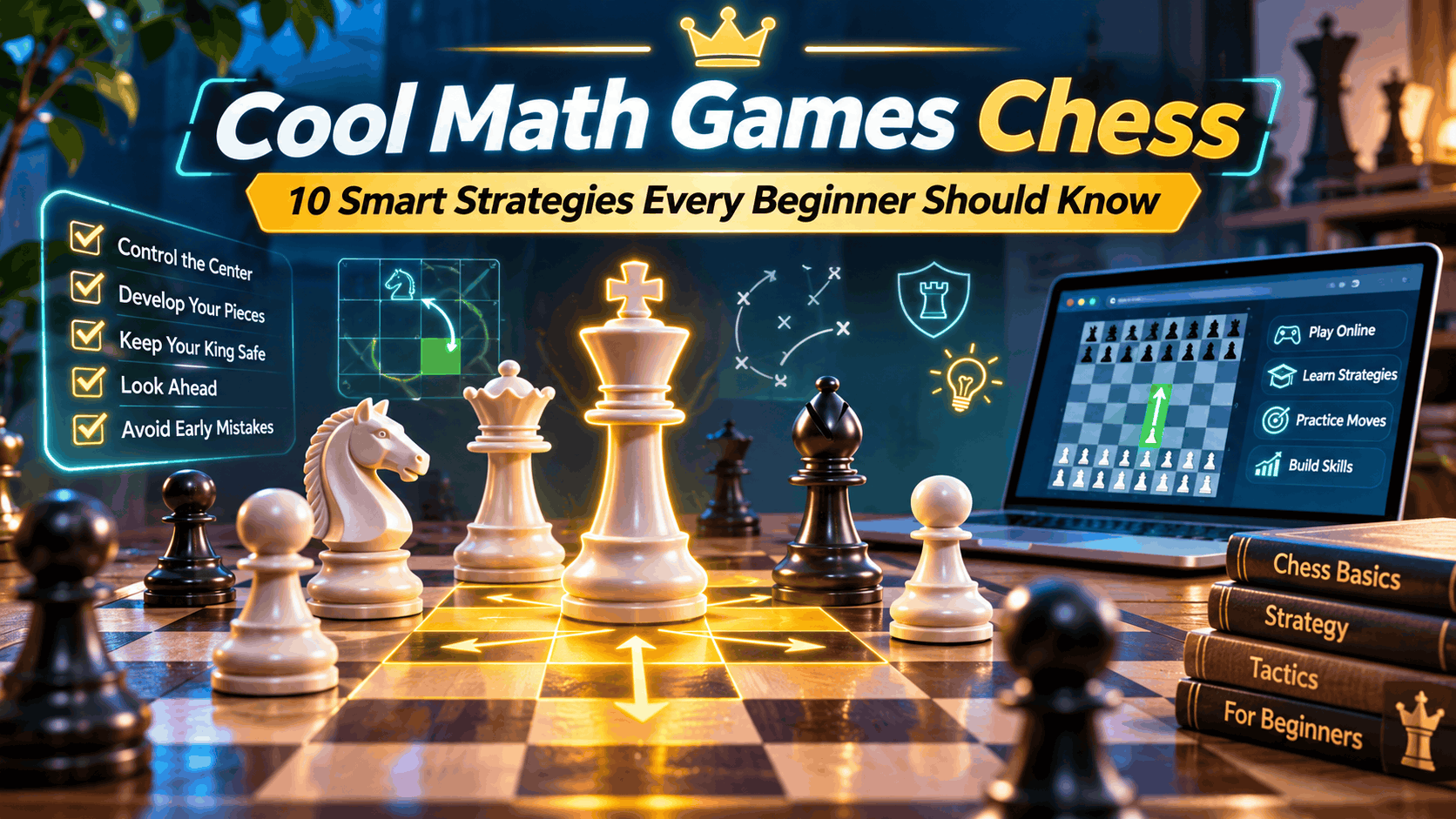
Chess can look simple when you first open the board. There are only 64 squares, two armies, and one clear objective: checkmate the opponent’s king. Yet after a few games, most beginners quickly realize that every move creates consequences. That is what makes cool math games chess so useful for new players. You can learn the rules, experiment with different ideas, and improve your decision-making without needing an expensive chess set or complicated software. More importantly, every game teaches you something about planning, patience, timing, and recognizing danger.
Unlike many casual free online games, chess does not reward random clicking or fast reactions alone. A move that looks strong can turn into a mistake several turns later. On the other hand, a quiet move that protects a piece or controls an important square can completely change the position.
If you are just starting, you do not need to memorize hundreds of openings. You need a small set of reliable habits. The following strategies will help you play with more confidence and understand why good moves work.
What Is Cool Math Games Chess?
Cool Math Games Chess gives players a browser-based way to practice one of the world’s most famous strategy games. The basic rules remain the same as traditional chess: each side begins with 16 pieces, and the goal is to place the opposing king in checkmate.
Every piece has its own movement pattern. Pawns move forward, bishops travel diagonally, rooks move in straight lines, knights jump in an L-shape, queens combine rook and bishop movement, and kings move one square at a time.
What separates chess from many other free online games is the amount of thinking involved. There is no luck-based spinner or random roll deciding your next action. Every position develops from the choices made by both players.
That means improvement comes from understanding patterns, spotting threats, and making better decisions.
Why Chess Is Good for Strategic Thinking
Chess rewards players who think beyond the current move.
Instead of asking only, “What can I capture?” strong players also think:
- What is my opponent threatening?
- Which pieces are currently unprotected?
- What happens after I move this piece?
- Can I improve my king’s safety?
- Which squares are important?
- Do I have a long-term plan?
This kind of thinking helps develop concentration, pattern recognition, planning, and decision-making.
Beginners often focus on immediate opportunities. Experienced players look at the entire position. That difference is one of the biggest reasons regular practice can make your chess improve quickly.
10 Smart Strategies for Cool Math Games Chess Beginners
1. Learn Exactly How Every Piece Moves
Before worrying about clever tactics, make sure you understand every piece.
Knights are usually the most confusing because they move two squares in one direction and then one square sideways. They are also the only pieces that can jump over other pieces.
Bishops stay on the same color throughout the game. Rooks work best on open files. Queens are extremely powerful but vulnerable when exposed too early.
Beginner example: If your opponent places a rook on an open file, you should understand how far it can attack before moving another piece onto that line.
Practical tip: Spend a few games focusing on legal moves and piece movement rather than trying to win quickly.
Common mistake: Forgetting that a piece protecting another piece may also be pinned and unable to move safely.
2. Control the Center of the Board in Cool Math Games Chess
The four central squares—e4, d4, e5, and d5—are extremely important because pieces placed near the center usually have more options.
For example, a knight in the middle of the board can attack several squares. A knight trapped near the edge has far fewer useful moves.
Beginners can often improve immediately by moving central pawns early.
A simple first move such as 1.e4 or 1.d4 helps claim space and opens paths for bishops and the queen.
Practical tip: Try to influence the center with pawns and developing pieces.
Common mistake: Moving several side pawns while allowing the opponent to dominate the middle.
3. Develop Knights and Bishops Early
In chess, development means bringing your pieces from their starting squares into useful positions.
Your knights and bishops usually need to enter the game early.
A common beginner approach is:
- Move a central pawn
- Develop a knight
- Develop another knight or bishop
- Prepare to castle
This gives your pieces activity while helping protect your king.
Beginner example: A knight on f3 controls important central squares and can help defend the king.
Practical tip: Ask yourself whether a move develops a new piece.
Common mistake: Moving the same knight three or four times while the rest of your pieces remain stuck on their starting squares.
4. Avoid Moving the Queen Too Early
The queen is the strongest piece on the board, so beginners naturally want to use it immediately.
That can be dangerous.
If you bring your queen into the center too early, your opponent may develop pieces while attacking it. You then waste moves protecting or relocating the queen while your opponent improves their position.
Example: You move your queen aggressively toward the opponent’s king. Your opponent develops a knight and attacks it. You move the queen again. Then a bishop attacks it, forcing another move.
Your opponent has gained development while you have spent multiple turns moving one piece.
Practical tip: Develop your minor pieces before launching major queen attacks.
Common mistake: Trying to win quickly with an unsupported queen.
5. Castle Early and Protect Your King
Castling is a special move involving the king and one rook. It helps move your king toward safety while activating the rook.
Beginners often leave their king in the center for too long.
That can become dangerous once the center begins opening.
A king surrounded by developed enemy pieces can quickly come under attack.
Practical tip: Whenever possible, develop your pieces and castle during the opening.
Common mistake: Delaying castling because you are busy chasing pawns or looking for early checks.
King safety usually matters more than winning one extra pawn.
6. Keep Your Pieces Protected
Every time you move a piece, check whether it is defended.
A piece left undefended is often called a hanging piece. Beginners lose many games simply because they forget that a knight, bishop, rook, or queen can be captured for free.
Learning basic piece values also helps:
- Pawn = 1
- Knight = about 3
- Bishop = about 3
- Rook = about 5
- Queen = about 9
This concept is called material advantage.
If you lose a queen for a bishop, you have probably made a costly trade. If you win a rook while losing only a pawn, you have gained material.
Practical tip: Before completing your move, ask, “Can my opponent capture this piece?”
Common mistake: Focusing so much on your attack that you ignore your opponent’s threats.
7. Think Before Every Move
One simple habit can dramatically improve beginner chess:
Do not move immediately.
Before playing any move, check three things:
- Is my king in danger?
- What did my opponent’s last move threaten?
- Is the piece I want to move safe?
This short pause prevents many avoidable mistakes.
You should also look for your opponent’s checks, captures, and threats before choosing your own move.
Fast play can be entertaining, but speed without awareness usually creates blunders.
Practical tip: Build a mental checklist before each move.
Common mistake: Playing the first legal move that looks interesting.
8. Learn Common Tactical Patterns
Chess tactics are short combinations that win material or create checkmate threats.
Three patterns every beginner should learn are the fork, pin, and skewer.
A fork happens when one piece attacks two or more pieces at once. Knights are especially good at forks.
A pin occurs when a piece cannot safely move because something more valuable behind it would be exposed.
A skewer is similar to a pin, except the more valuable piece is attacked first and must move, exposing the piece behind it.
For example, a bishop could attack the king and rook along the same diagonal. The king must move, allowing the bishop to capture the rook afterward.
Practical tip: Practice beginner tactical puzzles regularly.
Common mistake: Memorizing tactical names without learning to recognize them on the board.
9. Plan for Checkmate Instead of Chasing Pieces
Beginners often spend too much time chasing individual pieces.
Winning material is useful, but chess ends with checkmate, not with capturing every enemy piece.
A check means the king is under attack. A checkmate means the king is attacked and has no legal way to escape.
Rather than constantly attacking random pieces, ask how your pieces can cooperate around the opponent’s king.
A queen supported by a rook or bishop is much stronger than a queen attacking alone.
Practical tip: Coordinate your pieces before launching an attack.
Common mistake: Giving useless checks that simply push the opponent’s king toward safety.
10. Review Your Games and Learn From Mistakes
Improvement comes faster when you study your own games.
After losing, do not simply start another game. Try to identify the moment when your position became worse.
Maybe you lost a bishop.
Maybe you ignored a fork.
Maybe you left your king in the center.
Maybe you attacked without developing enough pieces.
Every mistake gives you something specific to improve.
Practical tip: After each game, identify one mistake and one move you were happy with.
Common mistake: Blaming the loss on one final move when the position may have been deteriorating for several turns.
Cool Math Games Chess vs Other Online Strategy Games
Chess shares some qualities with other browser games, but the decision-making process is different.
For example, games with dice often combine strategy with probability. You can make a smart decision and still receive an unlucky roll.
Chess has no dice. The board position comes entirely from player choices.
That makes every move more directly connected to the final result.
Players browsing games cool math games may enjoy many types of puzzles, action games, number games, and strategy titles. Chess stands out because it rewards long-term planning and careful calculation rather than fast reactions alone.
Both styles can be entertaining, but chess offers a particularly clear way to see how decisions create future opportunities.
Common Beginner Mistakes in Cool Math Games Chess
Even after learning basic strategy, new players often repeat a few predictable mistakes.
Moving the Same Piece Too Many Times
Repeatedly moving one knight or bishop wastes development time.
Bringing the Queen Out Too Early
An exposed queen can become a target and force you to lose valuable moves.
Ignoring King Safety
Attacking is exciting, but an unsafe king can end the game quickly.
Leaving Pieces Undefended
Before attacking, check whether the attacking piece is protected.
Playing Too Quickly
A few extra seconds can help you spot a hanging piece or tactical threat.
Focusing Only on Check
Not every check is useful. Sometimes improving a piece or controlling a key square is stronger.
How to Improve at Cool Math Games Chess
The best way to improve is consistent, focused practice.
Play regularly, but avoid playing mindlessly. One thoughtful game can teach you more than several rushed games.
Try combining game practice with:
- Beginner tactical puzzles
- Basic checkmate patterns
- Simple opening principles
- Review of lost games
- Practice against different skill levels
You do not need to memorize complicated opening theory immediately. Instead, learn basic principles such as center control, development, king safety, and piece protection.
Once those habits become automatic, more advanced ideas become easier to understand.
FAQ On Cool Math Games Chess
A. Start with how each piece moves, basic check and checkmate rules, piece values, development, center control, and simple tactical ideas such as forks and pins.
A. Not extensively. Beginners should first understand opening principles such as controlling the center, developing knights and bishops, and castling early.
A. The most important principle is developing your pieces while keeping your king safe. Good development creates more options and reduces the risk of early mistakes.
A. Play regularly, review your losses, practice tactical puzzles, protect your pieces, control the center, develop efficiently, and think before every move.
A. Yes. Cool math games chess can be a useful way for beginners to practice piece movement, basic tactics, strategic planning, and common chess patterns in an accessible online environment.
Final Thoughts On Cool Math Games Chess
Becoming better at chess does not require memorizing thousands of moves. It starts with better habits.
Learn how your pieces move. Control the center. Develop efficiently. Protect your king. Keep pieces defended. Most importantly, slow down enough to understand what is happening on the board.
The more you play cool math games chess, the easier it becomes to recognize familiar positions, tactical opportunities, and common mistakes. Each game gives you another chance to improve your planning and decision-making.
Among the many free online games available to beginners, chess remains especially rewarding because improvement is easy to notice. A move that confused you last week may become obvious after a little practice.
Keep playing, review your mistakes, and focus on making one thoughtful move at a time. That is how beginner chess gradually turns into confident chess.






One thought on “Cool Math Games Chess: 10 Smart Strategies Every Beginner Should Know”