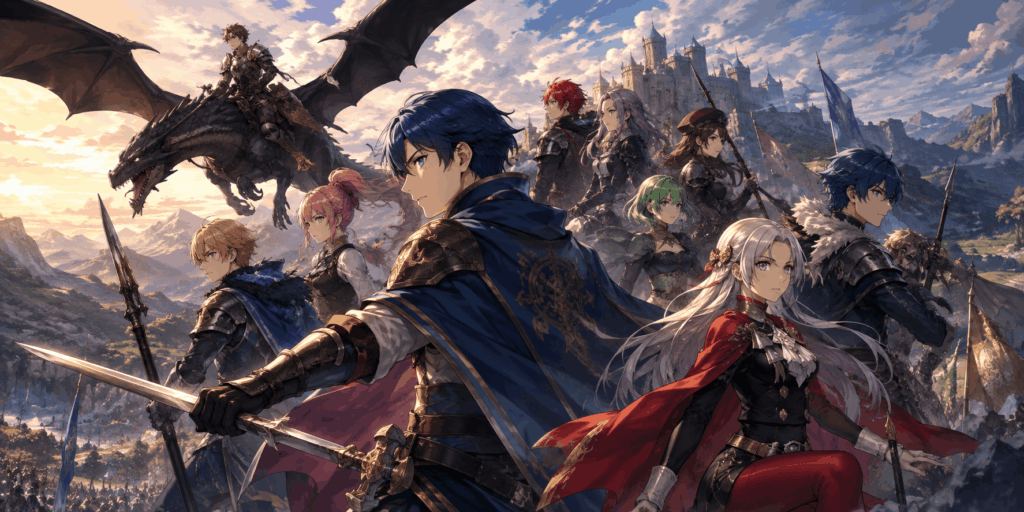


Few strategy RPG franchises have built a legacy quite like Fire Emblem. Since its beginnings in Japan, the series has evolved from challenging grid-based tactical battles into expansive adventures filled with memorable characters, branching stories, relationship systems, character customization, and high-stakes decisions.However, that long history creates a problem for newcomers: Which are the best Fire Emblem games, and which Fire Emblem game should you play first?
The short answer is Fire Emblem: Three Houses for most modern newcomers. However, Fire Emblem: Awakening remains an excellent introduction to the traditional formula, while Fire Emblem Engage is particularly appealing if tactical combat is your priority.
To make the choice easier, this guide ranks some of the best Fire Emblem games based on gameplay, accessibility, story, characters, tactical depth, replay value, and overall experience.
What Is Fire Emblem?
Fire Emblem is a tactical role-playing game (TRPG) series primarily associated with Nintendo and developer Intelligent Systems. Rather than relying on real-time action, most mainline games place characters on grid-based maps where players strategically move units, attack enemies, protect vulnerable allies, and complete mission objectives.
Consequently, positioning matters just as much as raw power.
Different characters typically specialize in particular weapons, classes, statistics, and abilities. Moreover, many entries include the franchise’s famous permadeath concept, where defeated characters can potentially be permanently lost when playing under Classic-style rules.
At the same time, modern Fire Emblem games have become increasingly accessible. Difficulty choices, Casual modes in many newer entries, relationship systems, and expanded character customization mean players can often tailor the experience to their preferred level of challenge.
Therefore, Fire Emblem isn’t simply about winning battles. Instead, its appeal comes from the combination of turn-based strategy, RPG progression, character relationships, fantasy storytelling, unit management, and meaningful tactical decisions.
Best Fire Emblem Games Ranked
1. Fire Emblem: Three Houses — Best Overall Starting Point
Best for: Newcomers, story-focused players, character development, and replayability
Fire Emblem: Three Houses is our top recommendation for someone discovering the franchise through a modern Nintendo system.
Released for Nintendo Switch in 2019, Three Houses received an 89 Metascore, with critics particularly praising its characters, narrative, tactical systems, and accessibility.
The adventure takes place on the continent of Fódlan and centers around Garreg Mach Monastery. As professor Byleth, you choose one of three student houses and train its members for future battles.
However, that choice becomes far more important as the story develops.
Each house introduces different characters, perspectives, motivations, and narrative paths. Therefore, completing one campaign doesn’t necessarily reveal everything the world has to offer.
Furthermore, Three Houses expands the familiar tactical RPG formula with teaching, exploration, recruitment, relationship building, classes, skills, and character development between battles.
Why play it first?
Because it combines accessibility with substantial depth. Beginners can gradually learn tactical combat, whereas experienced players can experiment with character builds, classes, equipment, positioning, and higher difficulties.
If you want one Fire Emblem game that demonstrates why the franchise has become so popular, Three Houses is an excellent place to begin.
2. Fire Emblem: Awakening — Best Introduction to Classic-Style Fire Emblem
Best for: Beginners who want a more traditional Fire Emblem experience
Before Three Houses dramatically expanded the franchise’s social and exploration elements, Fire Emblem: Awakening helped introduce a new generation of players to the series.
Released for Nintendo 3DS, Awakening follows Chrom, Robin, and their allies through a story involving kingdoms, war, dragons, relationships, and time-traveling characters.
More importantly, its gameplay provides a strong balance between accessibility and classic tactical mechanics.
Players manage units across grid-based battlefields while considering movement range, enemy positioning, weapons, classes, support relationships, and team composition. Meanwhile, its Pair Up mechanic lets characters fight alongside one another, adding another strategic layer.
Awakening is also notable for allowing relationships between certain characters to influence later parts of the game.
Therefore, players who enjoy building a personalized army may find themselves spending considerable time optimizing relationships and character combinations.
Why is Awakening still worth playing?
Because it offers a streamlined example of the core Fire Emblem formula without requiring the extensive monastery management found in Three Houses.
As a result, if your question is “Which Fire Emblem game should I play first to understand the traditional series?”, Awakening is one of the strongest answers.
3. Fire Emblem: Path of Radiance — Best for Classic Storytelling
Best for: Players who value story, world-building, and memorable protagonists
Fire Emblem: Path of Radiance originally appeared on Nintendo GameCube and introduced players to Ike, who would eventually become one of the franchise’s most recognizable heroes.
Unlike stories centered primarily around royal protagonists, Path of Radiance follows Ike’s growth from a relatively inexperienced mercenary into a leader caught within a much larger conflict.
That perspective gives the adventure a distinctive identity.
Furthermore, the game explores political conflict, prejudice, war, social divisions, and responsibility while maintaining the tactical battles expected from Fire Emblem.
The result is a particularly strong combination of narrative progression and strategy.
However, accessibility is the main obstacle for modern players because original hardware and legitimate copies can be harder to obtain than current Fire Emblem releases.
Nevertheless, for players exploring the history of the best Fire Emblem games, Path of Radiance remains an important entry.
4. Fire Emblem: The Sacred Stones — Best for Retro Beginners
Best for: Players who want an accessible older Fire Emblem adventure
Originally released for Game Boy Advance, Fire Emblem: The Sacred Stones is another excellent entry point.
The story follows royal siblings Eirika and Ephraim as their homeland becomes engulfed in conflict. Although the presentation is naturally simpler than modern Fire Emblem titles, the game’s fundamentals remain remarkably approachable.
Additionally, its world map provides opportunities to encounter additional battles, which can make character progression more flexible than in some older entries.
Therefore, newcomers interested in classic tactical RPG design may find The Sacred Stones less intimidating than some of the franchise’s more demanding installments.
Its combination of pixel-art presentation, focused storytelling, class progression, strategic maps, and memorable characters makes it a valuable introduction to old-school Fire Emblem.
5. Fire Emblem Engage — Best for Tactical Combat
Best for: Players who prioritize battles, customization, and strategy
If Three Houses emphasizes characters and social systems, Fire Emblem Engage puts a stronger spotlight on tactical combat.
Released for Nintendo Switch in 2023, Engage earned an 80 Metascore from critics. Reviews frequently highlighted its combat systems, although opinions about its storytelling were more mixed.
The game’s signature feature is its Emblem Ring system. Characters can synchronize with heroes inspired by previous Fire Emblem protagonists, gaining additional abilities and tactical possibilities.
Consequently, choosing which character receives which Emblem becomes an important strategic decision.
Engage also restores greater emphasis on the weapon triangle concept, encouraging players to think carefully about matchups rather than simply sending their strongest unit forward.
For that reason, Engage is one of the most enjoyable options for players primarily interested in turn-based tactical gameplay.
However, complete newcomers should understand that its callbacks to past heroes can carry more meaning after experiencing other Fire Emblem games.
6. Fire Emblem Echoes: Shadows of Valentia — Best for Something Different
Best for: Players seeking exploration and a distinctive Fire Emblem experience
Fire Emblem Echoes: Shadows of Valentia is a Nintendo 3DS remake of Fire Emblem Gaiden.
However, it doesn’t feel exactly like many other entries.
The game follows Alm and Celica along separate journeys while incorporating traditional tactical battles alongside explorable areas and dungeon elements.
Therefore, Echoes is especially interesting for players who already understand the Fire Emblem formula and want to see how flexible that formula can become.
Its presentation, character interactions, and different approach to progression give it a distinctive personality.
Although it wouldn’t necessarily be our first recommendation for a complete beginner, it is absolutely worth exploring after becoming comfortable with the series.
Which Fire Emblem Game Should You Play First?
The answer depends on what you value most.
| Player Type | Recommended Game |
|---|---|
| Complete beginner | Fire Emblem: Three Houses |
| Wants traditional Fire Emblem | Fire Emblem: Awakening |
| Loves tactical combat | Fire Emblem Engage |
| Wants strong classic storytelling | Path of Radiance |
| Loves retro strategy RPGs | The Sacred Stones |
| Wants something different | Echoes: Shadows of Valentia |
For most people, Three Houses is the safest starting recommendation because it provides approachable tactical combat alongside extensive character development and multiple story routes.
Nevertheless, there isn’t one universally correct starting point. In fact, recent fan discussions still frequently recommend Three Houses, Awakening, and The Sacred Stones to newcomers, illustrating how different entries appeal to different types of players.
What Makes the Best Fire Emblem Games So Addictive?
One major reason Fire Emblem remains compelling is that battles involve consequences.
For example, moving a fragile mage one square too far can expose them to an enemy attack. Conversely, positioning a defensive character correctly can protect multiple teammates and change the outcome of an entire encounter.
Therefore, successful play involves thinking several moves ahead.
Additionally, RPG progression creates a satisfying feedback loop. Characters earn experience, improve statistics, learn abilities, change classes, strengthen relationships, and gradually become more capable.
As a result, your army begins to feel personal rather than disposable.
Furthermore, characters often develop relationships through support conversations. Consequently, players aren’t simply controlling anonymous pieces on a strategy board; they’re protecting characters whose personalities and stories they have learned.
That combination of strategy + progression + attachment + consequences is one of Fire Emblem’s defining strengths.
Fire Emblem vs. Casual Online Free Games
Not every gaming session needs a huge tactical campaign.
Sometimes players simply want online free games that can be understood quickly and enjoyed without committing dozens of hours to a storyline. Browser games, puzzle games, card games, arcade titles, and dice games can fill that role particularly well.
However, the experience is fundamentally different.
Fire Emblem rewards long-term planning, character management, tactical positioning, and narrative investment. Meanwhile, casual games generally emphasize immediate entertainment and shorter play sessions.
Therefore, neither style needs to replace the other.
For instance, someone who enjoys probability and decision-making in tactical RPGs may also enjoy tabletop-inspired or fire dice games where every roll creates uncertainty.
One example is Schnyders Dice of Fire, a dice-focused game that offers a very different type of gaming experience from Fire Emblem. Instead of managing fantasy armies on tactical grids, dice-centered games emphasize probability, risk, and the unpredictable outcome of each roll.
Similarly, players searching for terms such as crazy games, cazy games, or even misspellings like cray games are often looking for fast, accessible entertainment rather than a lengthy tactical RPG.
Therefore, Fire Emblem is better suited to players who want strategy and long-term progression, whereas casual online games are useful when you want something quicker and easier to jump into.
How to Choose the Right Fire Emblem Game
Before selecting your first title, consider three questions.
Do you care more about story or combat?
If story, relationships, and characters are your priority, start with Three Houses. However, if intricate tactical battles matter more, consider Engage.
Do you prefer modern or retro games?
Modern players will probably feel more comfortable with Three Houses or Engage. Conversely, retro RPG fans may appreciate The Sacred Stones and other earlier entries.
How much complexity do you want?
Fire Emblem can become surprisingly deep. Classes, statistics, skills, weapon choices, supports, positioning, terrain, and difficulty settings can all influence battles.
Fortunately, you don’t need to master everything immediately. Start with an approachable difficulty, understand movement and attack ranges, and gradually experiment with more advanced strategies.
Frequently Asked Questions About the Best Fire Emblem Games
A. No. Mainline Fire Emblem console games are commercial Nintendo titles rather than browser-based free games. Fire Emblem Heroes, however, is a free-to-start mobile title, though its structure differs substantially from the traditional console experience.
A. Yes. Modern entries offer difficulty and gameplay options that make the series significantly more approachable. However, Fire Emblem still requires more strategic thinking and time investment than most casual online free games.
A. Generally, no. Many Fire Emblem titles tell self-contained stories with their own worlds and casts. However, certain games are directly connected, so playing related entries in sequence can improve your understanding of those particular stories.
A. Players who prioritize tactical systems should strongly consider Fire Emblem Engage. Its Emblem mechanics, unit customization, weapon interactions, and map-based strategy put combat at the center of the experience.
A. Three Houses is an excellent modern starting point. Meanwhile, Awakening is arguably better for newcomers who specifically want to learn a more traditional version of the Fire Emblem formula.
A. Fire Emblem: Three Houses is our best overall recommendation because it combines tactical gameplay, character development, multiple narrative paths, customization, and strong replay value. It also holds an 89 Metascore.
The Future of Fire Emblem
The franchise is continuing to evolve. As of August 2026, the next major entry is Fire Emblem: Fortune’s Weave, scheduled for Nintendo Switch 2 on September 17, 2026. Recent previews indicate that it retains familiar grid-based tactical combat while introducing interconnected protagonist storylines and new mechanics.
Therefore, newcomers have another reason to explore earlier titles now: understanding the series’ established ideas can provide useful context before its next chapter arrives.
Final Verdict: Where Should You Start?
The best Fire Emblem games succeed because they make strategy feel personal. Every battlefield asks you to consider positioning, weapons, abilities, character strengths, enemy threats, and potential consequences. Meanwhile, RPG progression and character relationships give those tactical decisions emotional weight.
For most newcomers, Fire Emblem: Three Houses is the best place to start. It is approachable, story-rich, highly replayable, and offers enough strategic depth to demonstrate what makes Fire Emblem special.
However, players seeking a more traditional experience should consider Fire Emblem: Awakening, while strategy-first players should try Fire Emblem Engage. Meanwhile, Path of Radiance and The Sacred Stones remain excellent choices for anyone interested in the franchise’s classic era.
Ultimately, there is no single Fire Emblem game that suits every player. Instead, the right starting point depends on whether you value storytelling, tactical depth, retro design, customization, or accessibility.
Choose the experience that matches your preferences, learn the battlefield one turn at a time, and you’ll quickly understand why Fire Emblem remains one of gaming’s most enduring tactical RPG franchises.