



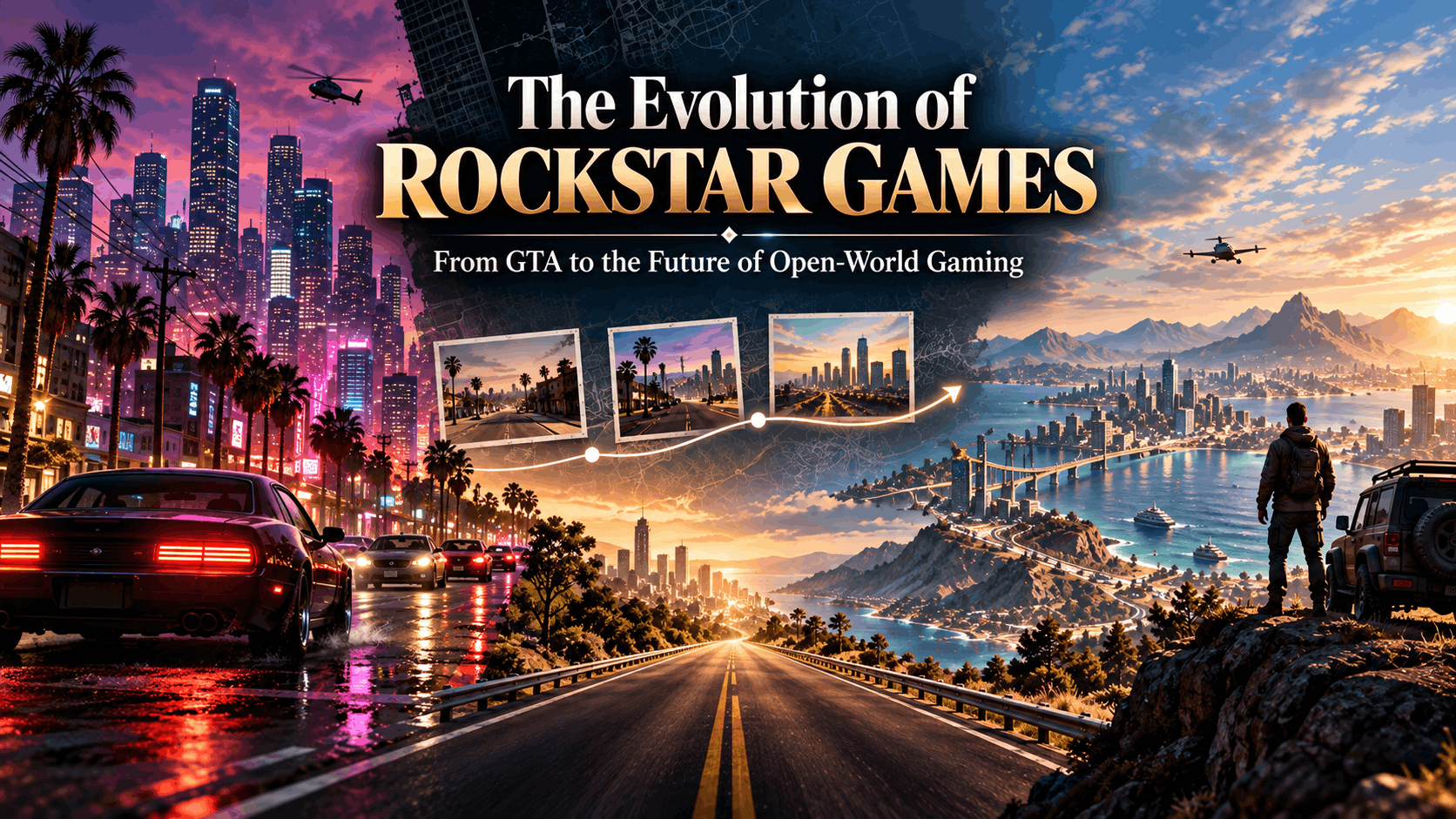
Few video game companies have influenced modern open-world design as deeply as Rockstar Games. From the early freedom of Grand Theft Auto to the remarkably detailed world of Red Dead Redemption 2, Rockstar has repeatedly expanded what players expect from interactive environments, storytelling, exploration, and sandbox gameplay.
More importantly, Rockstar’s evolution mirrors the evolution of the open-world genre itself. Games once offered relatively simple cities where players could drive around and complete missions. Today, however, Rockstar’s worlds contain complex characters, dynamic activities, cinematic narratives, online communities, detailed environments, and systems designed to make virtual locations feel increasingly believable.
Now, with Grand Theft Auto VI approaching, another major chapter in Rockstar Games history is about to begin.
What Is Rockstar Games?
Rockstar Games is a video game publisher and development organization best known for creating story-driven, open-world action-adventure games such as Grand Theft Auto and Red Dead Redemption.
The company celebrated its 25th anniversary in December 2023, which traces the Rockstar Games story back to 1998. Over the following decades, it developed or published franchises including Grand Theft Auto, Red Dead Redemption, Max Payne, Bully, Midnight Club, Manhunt, and L.A. Noire.
Although these franchises differ significantly in setting and gameplay, they frequently share one philosophy: give players a convincing world and enough freedom to experience it in their own way.
Consequently, Rockstar became closely associated with the term open-world gaming.
GTA III Changed the Meaning of an Open-World Game
Although the original Grand Theft Auto games had already introduced freedom-based gameplay, Grand Theft Auto III, released in 2001, represented a major technological and creative breakthrough.
Instead of presenting its world primarily from a top-down perspective, GTA III placed players inside a fully 3D version of Liberty City. Furthermore, players could drive vehicles, explore neighborhoods, complete story missions, discover optional activities, listen to fictional radio stations, and simply experiment with the game’s systems.
Rockstar itself describes GTA III as the game that established its approach to building detailed 3D open worlds with freedom, nonlinear gameplay, and cinematic storytelling.
Therefore, GTA III was important not simply because its city was large. Rather, it demonstrated that an open world could become part of the storytelling.
Liberty City was not merely a background. It was part of the experience.
Vice City and San Andreas Expanded the Formula
After GTA III established the foundation, Grand Theft Auto: Vice City refined it.
Its fictional interpretation of 1980s Miami combined neon environments, music, fashion, crime stories, vehicles, and cultural satire. As a result, the setting developed a personality that was almost as memorable as its characters.
Then came Grand Theft Auto: San Andreas.
San Andreas expanded Rockstar’s formula with multiple cities, countryside, character customization, statistics, vehicles, activities, and a significantly broader environment. Consequently, the idea of an open-world game began moving beyond simply “exploring a big map.”
Instead, players increasingly expected worlds filled with systems, activities, characters, and opportunities for experimentation.
That expectation continues to influence many popular games today.
GTA IV Brought Greater Realism
With Grand Theft Auto IV, Rockstar shifted toward a more grounded interpretation of Liberty City.
Physics became more sophisticated, character animation improved, and the narrative focused heavily on protagonist Niko Bellic and his attempt to build a new life in America.
Meanwhile, Rockstar continued improving how pedestrians, vehicles, police, missions, and environmental details interacted.
This development was important because open-world games were becoming increasingly complex simulations. Players were no longer impressed simply because they could travel across a large map. Instead, they wanted environments that responded convincingly to their actions.
Therefore, Rockstar’s design philosophy increasingly focused on world depth as well as world size.
GTA V Turned an Open World Into a Long-Term Platform
Released originally in 2013, Grand Theft Auto V represented another major turning point.
For the first time in a main GTA story, players could switch between three protagonists: Michael, Franklin, and Trevor. Moreover, Los Santos and the surrounding region offered activities ranging from missions and vehicle customization to sports, exploration, property systems, and random encounters.
However, GTA V’s most important long-term contribution may have been GTA Online.
Rather than treating multiplayer as a short-lived extra mode, Rockstar continued expanding GTA Online through new missions, vehicles, properties, activities, heists, businesses, and other updates.
Consequently, GTA became both a single-player franchise and an ongoing online ecosystem.
The commercial scale has been enormous. According to Take-Two’s August 2026 investor materials, the Grand Theft Auto franchise has reached nearly 475 million units sold-in, while GTA V alone has exceeded 230 million units worldwide.
Those figures help explain why GTA remains one of the most recognizable names among modern popular games.
Red Dead Redemption 2 Took Immersion Further
Although GTA receives much of the attention surrounding Rockstar Games, Red Dead Redemption 2 demonstrated another side of the company’s open-world philosophy.
Released in 2018, the game placed players in an enormous representation of the American frontier and followed Arthur Morgan and the Van der Linde gang.
However, its most impressive achievement was not simply map size.
Instead, Rockstar concentrated heavily on detail.
Animals interact with ecosystems. Towns contain routines and activities. Characters react to player behavior. Weather, clothing, horses, weapons, camps, conversations, and environmental animations all contribute to the illusion of a living world.
Additionally, Rockstar designed the game so that story, exploration, and player choice often flow naturally into one another.
That approach proved remarkably successful. Take-Two reported in August 2026 that Red Dead Redemption 2 had sold-in more than 87 million units, while the Red Dead Redemption series had approached 116 million units.
Therefore, Red Dead Redemption 2 became an important example of how open-world developers can prioritize density, atmosphere, interaction, and environmental storytelling, rather than relying only on enormous maps.
Rockstar Games vs. Free Online Games and 2 Player PS5 Games
Modern gaming audiences search for many different experiences. Some players want massive story-driven adventures, while others specifically search for free online games, quick multiplayer titles, or 2 player PS5 games they can enjoy together.
Rockstar occupies a somewhat different position.
Its major releases generally focus on premium, large-scale experiences designed around exploration, storytelling, and highly detailed worlds. GTA Online and Red Dead Online add social and multiplayer elements; however, Rockstar’s core design reputation comes from expansive interactive worlds rather than traditional local couch co-op.
Therefore, someone searching specifically for 2 player PS5 games may have different priorities from a player looking for GTA-style sandbox gameplay.
Similarly, free online games often prioritize instant accessibility and short play sessions. Rockstar’s flagship experiences, by contrast, typically emphasize longer narratives, character progression, exploration, cinematic presentation, and persistent virtual worlds.
Nevertheless, all these categories demonstrate how diverse gaming has become.
GTA VI and the Next Evolution of Rockstar Games
The next major milestone is Grand Theft Auto VI.
Rockstar has officially scheduled GTA VI for November 19, 2026, on PlayStation 5 and Xbox Series X|S. The game returns players to Vice City while expanding beyond the city into the fictional state of Leonida. Its story centers on Jason Duval and Lucia Caminos, whose lives become connected after a criminal job goes wrong.
Furthermore, Rockstar describes GTA VI as the biggest and most immersive evolution of the Grand Theft Auto series so far. An extended gameplay presentation released in August 2026 was captured from in-game footage running on PlayStation 5.
While it is sensible to avoid predicting unconfirmed gameplay features, the official material already indicates that Rockstar is continuing its long-standing focus on large environments, detailed characters, cinematic storytelling, cultural observation, music, and environmental immersion.
As a result, GTA VI represents more than another sequel. It provides an opportunity to see how one of gaming’s most influential open-world developers interprets the expectations of a new hardware generation.
What Is the Future of Open-World Gaming?
The future of open-world gaming is unlikely to depend simply on creating bigger maps.
Instead, the next generation will probably be judged by how believable, interactive, responsive, and meaningful those worlds feel.
For example, future open-world experiences may increasingly emphasize:
- More responsive NPC behavior
- Greater environmental interaction
- Deeper emergent gameplay systems
- More natural transitions between missions and exploration
- More convincing animation and physics
- Richer online social experiences
- Dynamic world events
- Stronger character-driven storytelling
- Higher environmental density
- More personalized ways to approach objectives
Therefore, immersion may matter more than raw map size.
Rockstar’s history already reflects that transition. GTA III introduced groundbreaking 3D freedom. San Andreas increased scale and activities. GTA IV pursued realism. GTA V combined storytelling with a long-running online world. Red Dead Redemption 2 pushed environmental detail dramatically further.
Now, GTA VI is positioned to continue that progression.
Frequently Asked Questions About Rockstar Games
Rockstar helped popularize the modern 3D open-world formula through GTA III and continued developing the genre through increasingly complex environments, narratives, multiplayer systems, and interactive worlds.
GTA VI takes place in the fictional state of Leonida, including a modern version of Vice City and several surrounding locations.
Grand Theft Auto VI is officially scheduled for November 19, 2026, for PlayStation 5 and Xbox Series X|S.
Based on Take-Two’s August 2026 figures, Grand Theft Auto V is Rockstar’s biggest-selling individual release, with more than 230 million units sold-in worldwide.
Rockstar Games is best known for the Grand Theft Auto and Red Dead Redemption franchises, particularly their large open worlds, cinematic narratives, detailed environments, and player freedom.
Final Thoughts
The evolution of Rockstar Games shows how dramatically open-world gaming has changed over the past quarter-century.
What began with comparatively simple freedom and exploration has grown into highly detailed digital worlds capable of supporting cinematic stories, multiplayer communities, environmental simulation, exploration, and hundreds of hours of gameplay.
Moreover, Rockstar’s influence extends beyond GTA. From the atmosphere of Red Dead Redemption to the investigative experimentation of L.A. Noire and the rebellious school setting of Bully, the company has repeatedly explored how interactive environments can become storytelling tools.
Ultimately, the future of open-world games will not be determined by which developer creates the largest map. Instead, success will increasingly depend on how alive that map feels, how meaningful its systems are, and how much freedom players have within it.
With GTA VI scheduled for November 2026, Rockstar Games is preparing to test those expectations once again—and the next stage of open-world gaming may be shaped by what happens in Vice City and beyond.






One thought on “The Evolution of Rockstar Games: From GTA to the Future of Open-World Gaming”