



Dice games prove that you do not need complicated equipment, lengthy rulebooks, or hours of preparation to have a good time. In fact, some of the best simple dice games can be learned within minutes. All you need is a set of dice, a few players, and a basic understanding of the objective.
Moreover, dice games work for many different settings. Families can play them during game night, friends can use them as quick party activities, and teachers can adapt them for lessons involving counting, probability, addition, multiplication, and decision-making. Research on game-based learning has also found that dice-based activities can increase engagement and interest while helping learners understand probability-related concepts.
Meanwhile, digital gaming has given traditional dice mechanics a new life. Online dice games can now combine familiar rolling and scoring systems with multiplayer competition, leaderboards, tournaments, and other interactive features.
Quick Answer: What Are the Best Simple Dice Games?
Simple dice games are games built around easy-to-understand rolling, scoring, matching, bluffing, or risk-and-reward mechanics. Some of the best options include Schnyder’s Dice of Fire, Pig, Farkle, Yahtzee, Liar’s Dice, Ship, Captain and Crew, Bunco, Tenzi, Shut the Box, Going to Boston, Left Center Right, Beetle, Chicago, Mexico, and Race to 100.
For beginners, Pig, Going to Boston, Beetle, and Race to 100 are particularly easy to understand. However, players who want more strategy can explore Schnyder’s Dice of Fire, Farkle, Yahtzee, and Liar’s Dice.
Why Are Simple Dice Games So Popular?
One reason dice games remain popular is accessibility. Usually, players need only standard six-sided dice, which are also known as D6 dice. Additionally, many games require little or no setup.
However, simplicity does not necessarily mean a lack of strategy. In many games, players must decide whether to continue rolling, protect their existing score, challenge another player, or pursue a difficult scoring combination.
Consequently, dice games often combine several engaging mechanics:
- Randomness and probability
- Risk-versus-reward decisions
- Score management
- Pattern recognition
- Mental arithmetic
- Bluffing and social deduction
- Competitive multiplayer gameplay
- Strategic decision-making
Therefore, a popular dice game can appeal to complete beginners while still providing enough uncertainty and strategy to keep experienced players interested.
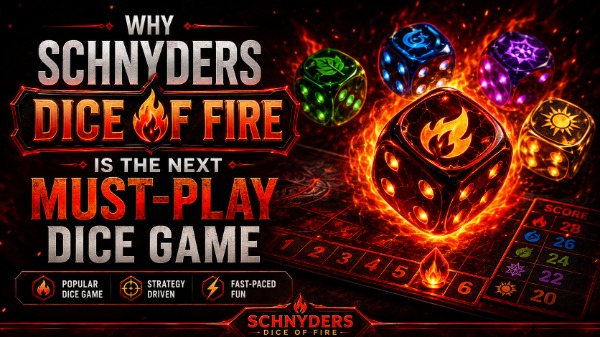
1. Schnyder’s Dice of Fire Popular Dice Games
Best for: Online multiplayer competition and risk-taking
Players: 2 or 4
Style: Digital multiplayer dice game
Main goal: Get on the board and race toward 10,000 points
At the top of our list is Schnyder’s Dice of Fire, a modern multiplayer experience that takes familiar dice-based risk-and-reward mechanics and turns them into a competitive digital game.
Unlike a basic roll-and-score game, Schnyder’s gives players an important decision throughout a turn: Should you bank what you have earned or continue rolling for a potentially larger score?
First, players need to score 1,000 points in a single turn to get on the board. After achieving that milestone, the main race toward 10,000 points begins. Additionally, the game includes mechanics such as the Vizeene (Red Die), Hot Dice, 950 Must Bust, a final-round system, and global leaderboard competition. Its official description also lists real-time two- and four-player matches.
Therefore, the basic objective is understandable, yet every turn can involve meaningful risk.
For example, imagine that you have already accumulated a valuable unbanked score. You could stop and protect those points. On the other hand, you could continue rolling and attempt to build an even stronger turn. If the next roll goes badly, however, that decision could cost you.
That push-your-luck structure is particularly important because it makes luck only one part of the experience. Players also need to think about timing, scoring opportunities, their opponents’ positions, and how much risk they can reasonably accept.
2. Pig
Best for: Complete beginners
Players: 2+
Dice needed: 1
Main goal: Be the first to reach the agreed score, commonly 100
Pig is one of the easiest dice games to teach because it revolves around one decision: roll again or stop?
During a turn, a player repeatedly rolls one die and adds the results to their temporary turn score. However, rolling a 1 normally ends the turn and causes the player to lose the unbanked points from that turn. Therefore, players must decide when their temporary total is large enough to save.
For example, if you have earned 18 points during your turn, you can bank them. Alternatively, you can roll again and try to increase the total.
Because of this simple mechanic, Pig is an excellent introduction to probability, risk assessment, and strategic thinking.
3. Farkle
Best for: Risk-and-reward strategy
Players: 2+
Dice needed: 6
Main goal: Build a high total using scoring dice and combinations
Farkle adds another layer of strategy to the push-your-luck formula.
Generally, players roll six dice and set aside scoring dice or combinations. After scoring, they can either bank their points or continue rolling the remaining dice. However, if a roll produces no valid scoring dice, the player “Farkles” and normally loses the unbanked points from that turn.
Consequently, the game creates an ongoing question: Is another roll worth the risk?
Moreover, different groups sometimes use slightly different scoring rules. Therefore, everyone should agree on the scoring system before starting.
4. Yahtzee
Best for: Combination building
Players: 1+
Dice needed: 5
Main goal: Create valuable combinations across scoring categories
Yahtzee is one of the most recognizable dice games because it combines luck with planning.
Typically, a player rolls five dice and can roll up to three times during a turn. Between rolls, the player chooses which dice to keep and which ones to reroll. Therefore, the challenge is not simply rolling high numbers. Instead, players are attempting to complete specific scoring combinations.
For example, you may pursue three of a kind, four of a kind, a straight, a full house, or five matching dice.
As a result, Yahtzee encourages probability awareness and forward planning while remaining relatively easy to learn.
5. Liar’s Dice
Best for: Bluffing and social groups
Players: 2+
Equipment: Dice and concealed cups
Main goal: Make accurate bids while detecting opponents’ bluffs
Liar’s Dice changes the experience because players do not have complete information.
Each player rolls dice secretly and looks only at their own results. Then, players make increasingly high claims about how many dice of a particular value exist across the table.
Eventually, someone challenges a bid.
Therefore, success depends on more than the numbers in front of you. Players must estimate probability while also reading their opponents and deciding whether a claim is believable.
Consequently, Liar’s Dice is particularly entertaining for groups that enjoy bluffing, psychology, and social interaction.
6. Ship, Captain and Crew
Best for: Quick competitive rounds
Players: 2+
Dice needed: 5
Main goal: Roll a 6, 5, and 4 in sequence before maximizing the remaining dice
Ship, Captain and Crew has an objective that is easy to remember:
6 = Ship
5 = Captain
4 = Crew
Players generally have limited rolls to collect those numbers in order. Once the ship, captain, and crew are secured, the remaining dice determine the player’s cargo score.
Therefore, the game combines sequencing with luck while requiring very little preparation. Its simple structure also makes it suitable for short rounds between longer games.
7. Bunco
Best for: Parties and larger groups
Dice needed: 3 per table
Style: Social team dice game
Bunco is designed around quick rounds, rotating players, and social interaction.
During each round, players attempt to roll the number corresponding to that round. For instance, players target ones during the first round, twos during the second, and so forth.
Additionally, matching dice can produce points, while certain three-of-a-kind results can generate larger scoring opportunities depending on the rules being used.
Because players rotate and interact frequently, Bunco is less about deep individual strategy and more about maintaining a lively social atmosphere.
8. Tenzi
Best for: Speed and energetic play
Players: 2+
Dice needed: Usually 10 per player
Main goal: Make all your dice show the same number
Tenzi is extremely easy to understand.
First, everyone rolls their dice simultaneously. Next, each player chooses a target number, keeps dice showing that number, and repeatedly rerolls the others.
The first player to make all their dice match wins.
Therefore, Tenzi is ideal when you want something fast rather than a long strategy game. Moreover, because everyone plays simultaneously, there is almost no waiting between turns.
9. Shut the Box
Best for: Mental arithmetic
Players: 1+
Dice needed: Usually 2
Main goal: Eliminate as many numbered tiles as possible
Shut the Box combines dice rolling with basic arithmetic.
Players roll two dice, calculate the total, and then close available numbered tiles that equal that total.
For example, after rolling an 8, a player might close the 8 tile. Alternatively, depending on the rules, they might close combinations such as 5 and 3.
Therefore, players constantly evaluate different number combinations.
For children, this can reinforce addition and number sense. For adults, meanwhile, it becomes a relaxing probability and optimization challenge.
10. Going to Boston
Best for: Fast family games
Players: 2+
Dice needed: 3
Main goal: Build the highest total
Going to Boston is straightforward enough for beginners.
First, roll three dice and keep the highest one. Then, roll the remaining two dice and keep the highest again. Finally, roll the last die.
Add the three retained values together to create your score for the round.
After everyone completes the agreed number of rounds, the highest total wins.
Because the rules require almost no memorization, Going to Boston works particularly well as a quick introduction to simple dice games.
11. Left Center Right
Best for: Larger casual groups
Players: 3+
Main goal: Be the last player holding counters
Left Center Right, commonly called LCR, focuses more on social fun than strategy.
Players roll special dice that determine whether they pass counters left, pass them right, place them in the center, or keep them.
Although players have limited control over the outcome, that unpredictability is exactly what makes the game entertaining.
Therefore, LCR is a strong choice when your group wants an easy game that does not require complicated calculations or lengthy explanations.
12. Beetle
Best for: Kids and creative play
Players: 2+
Dice needed: 1
Main goal: Complete a beetle drawing
Beetle transforms each dice roll into part of a drawing challenge.
Different numbers correspond to different body parts. For example, one number might allow a player to draw the body, while another adds a leg, antenna, or eye.
However, some parts may need to be drawn before others. Therefore, players cannot necessarily complete their beetle simply by rolling every required number once.
The first player to finish the entire beetle wins.
As a result, Beetle combines chance, creativity, and simple rule-following in a format that works especially well for younger players.
13. Chicago
Best for: Simple scoring competition
Players: 2+
Dice needed: 2
Main goal: Hit target totals across multiple rounds
Chicago is another easy game based on rolling two dice.
Each round has a target number. Players roll and attempt to match that round’s target total. Consequently, scoring depends largely on whether the dice produce the required sum at the right time.
Although the rules are straightforward, the changing targets keep the game interesting.
Moreover, Chicago can provide a practical way for younger players to become more comfortable adding two dice quickly.
14. Mexico
Best for: Competitive short rounds
Players: 3+
Dice needed: 2
Main goal: Avoid having the weakest roll
Mexico is a fast dice game in which players compare two-die results according to a ranking system.
Usually, certain combinations have special values. Therefore, understanding the ranking order is important before starting.
Unlike longer scoring games, Mexico is built around short rounds. Consequently, the pressure appears quickly because one weak roll can put a player in a difficult position.
For groups looking for crazy dice games with rapid momentum and plenty of reactions around the table, this style of game can be particularly entertaining.
15. Race to 100
Best for: Children, classrooms, and beginners
Players: 2+
Dice needed: 2
Main goal: Reach 100 first
Race to 100 is both a game and a simple mathematics exercise.
Players roll two dice, add the values together, and add the result to their running total. Then, the next player takes a turn.
For example:
Roll: 4 + 5
Round score: 9
Previous total: 36
New total: 45
The first player to reach the target wins.
Although extremely simple, games of this kind can reinforce addition fluency, mental arithmetic, and number sense. Educational resources also use dice activities specifically for practicing these mathematical skills.
How to Choose the Right Dice Games
With so many choices available, start by considering who will be playing.
For complete beginners, try Pig, Going to Boston, Beetle, or Race to 100.
For strategic players, meanwhile, consider Schnyder’s Dice of Fire, Farkle, Yahtzee, or Shut the Box.
For party groups, Bunco, Liar’s Dice, Left Center Right, and Tenzi can create a more social experience.
For children and educational settings, Race to 100, Beetle, Pig, and Shut the Box can combine entertainment with counting, arithmetic, and decision-making.
Finally, players who prefer digital competition can explore online dice games such as Schnyder’s Dice of Fire, where traditional dice mechanics are combined with multiplayer features and competitive progression.
Frequently Asked Questions About Simple Dice Games
Yes. Numerous websites and mobile platforms provide free online dice games, although available titles, features, advertisements, and optional purchases vary by platform. Therefore, players should check the specific game’s terms before playing.
Schnyder’s Dice of Fire is an option for players seeking competitive online dice gameplay. It features real-time multiplayer matches, a race toward 10,000 points, special scoring mechanics, and leaderboard competition.
Farkle is a strong choice because its rules are relatively accessible while still providing risk-and-reward decisions. Meanwhile, Liar’s Dice works well for adults who enjoy bluffing and social strategy.
You can play Pig, Farkle, Ship, Captain and Crew, Going to Boston, Chicago, Race to 100, Liar’s Dice, and many other games using standard six-sided dice.
Pig is one of the easiest dice games for beginners. You need only one die, and the central decision is whether to keep rolling for more points or stop and bank your current turn score.
Final Thoughts on Dice Games
The biggest advantage of simple dice games is that almost anyone can start playing quickly. You do not need advanced gaming experience, expensive equipment, or complicated instructions. Instead, a handful of dice can create competition, suspense, strategy, learning, and plenty of memorable moments.
Moreover, there is a game for almost every type of player. Pig and Going to Boston keep things simple. Farkle and Yahtzee introduce deeper scoring decisions. Liar’s Dice adds bluffing, while Beetle and Race to 100 make dice accessible to younger players.
At the same time, modern online dice games are expanding what dice-based gameplay can offer. Schnyder’s Dice of Fire, for example, combines approachable rolling mechanics with risk management, real-time multiplayer competition, special scoring rules, and a race toward 10,000 points. Consequently, it earns the number-one position on this list for players interested in a modern and competitive take on dice gaming.