

You do not need a large group, an expensive board game, or complicated rules to enjoy a competitive game night. In fact, some of the most entertaining 2 player dice games require little more than a few dice, a score sheet, and someone willing to take a risk on the next roll.
Dice games work especially well for two people because turns move quickly. Moreover, many games create meaningful choices around probability, scoring, bluffing, and risk management. Consequently, they can appeal to couples, friends, siblings, parents and children, or anyone looking for an easy tabletop activity.
Research has also shown that game-based activities involving dice can increase engagement when people are learning concepts related to probability and random variables. Therefore, dice games can offer more than entertainment; depending on the game, they may also encourage mental math, strategic thinking, and decision-making.
So, which games deserve a place at your table?
This guide explores 15 of the best 2 player dice games, ranging from simple dice games and traditional favorites to modern multiplayer experiences.
Quick Answer: What Are the Best 2 Player Dice Games?
Some of the best dice games for two players include Schnyder’s Dice of Fire, Farkle, Yahtzee, Shut the Box, Pig, Liar’s Dice, Qwixx, Going to Boston, Chicago, Ship, Captain and Crew, Tenzi, Beetle, Mexico, Yard Dice, and Bunco adapted for two players.
The right choice, however, depends on what you want. For instance, Pig is excellent for beginners, while Liar’s Dice emphasizes bluffing. Meanwhile, Yahtzee rewards combination-building, and Schnyder’s Dice of Fire adds digital multiplayer competition and push-your-luck decisions.
1. Schnyder’s Dice of Fire Best For 2 Player Dice Games.
Best for: Competitive online dice gameplay
Players: 2 or 4
Main skills: Risk management, scoring decisions, timing
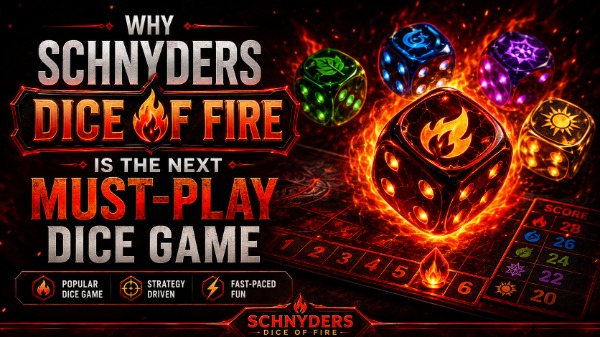
At the top of our list is Schnyder’s Dice of Fire, a fast-paced multiplayer dice game built around the constant decision of whether to bank points or continue rolling.
First, a player must score 1,000 points in a single turn to get on the board. Afterward, the main objective is to race toward 10,000 points. However, simply accumulating points is not enough because every additional roll can introduce more risk.
Furthermore, the game includes several distinctive mechanics. The Vizeene (Red Die) adds a high-risk, high-reward element, while 950 Must Bust prevents players from banking at that point. Additionally, Hot Dice situations can allow a player to keep the momentum going. Once someone reaches 10,000 points, the final-round mechanic gives opponents one last opportunity to respond.
Most importantly for this list, the game officially supports 2-player matches, as well as four-player competition.
As a result, Schnyder’s Dice of Fire stands out for players who enjoy traditional push-your-luck concepts but want them in a modern multiplayer format.
2. Farkle Popular 2 Player Dice Games
Best for: Push-your-luck competition
Players: 2+
What you need: Six dice and a score sheet
Farkle is one of the most recognizable popular dice games for players who enjoy balancing ambition against risk.
Generally, you begin your turn by rolling six dice. You then set aside scoring dice or combinations. After scoring, you face an important decision: bank the points you have already earned or roll the remaining dice for an opportunity to score more.
However, there is a catch. If a roll contains no scoring dice, you Farkle and lose the unbanked points accumulated during that turn. The traditional target is commonly 10,000 points.
For two people, this creates excellent head-to-head tension. For example, if your opponent is far ahead, taking additional risks might make sense. Conversely, when you already have a lead, banking smaller totals may be safer.
Therefore, Farkle turns straightforward dice rolling into a surprisingly engaging exercise in risk assessment.
3. Yahtzee
Best for: Combination building and score optimization
Players: Works well with two
What you need: Five dice, score sheets, and pencils
Yahtzee remains a classic choice because luck alone does not determine every decision.
During a standard turn, a player can roll five dice and selectively reroll dice, with up to three rolls available before choosing a scoring category. Therefore, each turn involves deciding which combination is realistically achievable and which dice should be preserved.
For example, you might begin with three matching numbers. At that point, you could chase a four-of-a-kind or Yahtzee. Alternatively, depending on your scorecard, pursuing another category might provide better value.
Because both players use their own scorecards, Yahtzee translates naturally into a two-player competition. Moreover, it rewards forward planning since every category can only be used according to the game’s scoring structure.
4. Shut the Box
Best for: Mental math and quick rounds
Players: 1+; excellent head-to-head
What you need: Two dice and numbered tiles
If you want simple dice games with an educational element, Shut the Box deserves serious consideration.
A typical board contains numbered tiles, often 1 through 9 or 1 through 12. First, a player rolls two dice. Next, they close an available number or combination of numbers totaling the roll.
Suppose you roll an 8. Depending on the available tiles and rules, you may be able to close 8 or combinations totaling 8. You continue until no legal combination matches your roll. Finally, the numbers remaining open determine your score, with lower totals generally being better.
Consequently, Shut the Box combines luck with arithmetic and tactical choices. It is particularly useful for families because younger players can practice addition while still participating in genuine competition.
5. Pig
Best for: Beginners and children
Players: 2+
What you need: One die
Few 2 player dice games are easier to teach than Pig.
On your turn, roll a die and accumulate points. Then choose whether to roll again or stop and bank your turn total. However, if you roll a 1, your turn normally ends and you lose the points accumulated during that turn.
Although the rules are remarkably simple, the decision-making can become interesting. Should you bank 15 points now, for example, or attempt another roll?
Because players repeatedly calculate running totals, Pig can also support basic mental arithmetic and probability discussions. Therefore, it is an excellent choice for families, classrooms, and beginners.
6. Liar’s Dice
Best for: Bluffing and reading your opponent
Players: 2+
What you need: Dice and opaque cups
Not every dice game revolves around maximizing visible scores. Liar’s Dice, by contrast, introduces hidden information and deception.
Each player rolls dice secretly beneath a cup. Then players make increasingly ambitious bids about how many dice of a particular face they believe exist across the combined hidden dice.
Eventually, someone challenges the previous claim. At that point, the dice are revealed and the bid is tested.
With only two players, the psychological element becomes especially noticeable because you are repeatedly evaluating the same opponent. Consequently, body language, betting patterns, probability, and bluffing all influence the experience.
7. Qwixx
Best for: Fast strategic scoring
Players: Two or more
Main appeal: Everyone stays involved
Qwixx offers a different experience from traditional roll-and-bank games.
Instead of simply accumulating points, players mark numbers across colored scoring rows based on dice combinations. Therefore, the challenge involves deciding which opportunities to take and which spaces to preserve for later.
Moreover, because choices made early can restrict later scoring possibilities, seemingly small decisions matter.
For two players, Qwixx offers an appealing combination of accessibility and strategy. It is especially suitable when you want something deeper than Pig but do not want a long or highly complicated game.
8. Going to Boston
Best for: Casual family play
Players: 2+
What you need: Three standard dice
Going to Boston is another accessible option among family dice games.
A common version starts with three dice. Roll all three, keep the highest die, and then roll the remaining two. Again, keep the highest result before rolling the final die. Add the three kept results together to determine your score for the round.
The player with the better total wins the round, and play can continue for an agreed number of rounds.
Because the rules require very little explanation, Going to Boston is ideal when you want to start playing immediately.
9. Chicago
Best for: Number recognition and casual competition
Players: 2+
What you need: Two dice
Chicago is built around rolling specific totals over a sequence of rounds.
Typically, each round has a target number. Therefore, players roll two dice and try to match that round’s required total. As the targets change, the probability of success changes as well.
This makes Chicago interesting from an educational perspective. For instance, players can observe that some totals occur more easily with two standard dice than others.
Consequently, Chicago can introduce basic probability concepts without making the activity feel like a math lesson.
10. Ship, Captain and Crew
Best for: Quick sequencing challenges
Players: 2+
What you need: Five dice
Ship, Captain and Crew gives players a specific sequence to pursue.
Traditionally, players try to obtain a 6 (ship), 5 (captain), and 4 (crew) in the correct order. Once those requirements are satisfied, the remaining dice determine the cargo score.
However, limited rolls create pressure. You may find the ship immediately but struggle to complete the remaining sequence.
Therefore, the game is straightforward enough for beginners while still producing suspenseful rounds between two competitors.
11. Tenzi
Best for: Speed and energetic gameplay
Players: Two or more
What you need: Multiple dice per player
If slow strategic games are not your style, Tenzi offers a much faster alternative.
Rather than taking long alternating turns, players generally roll simultaneously while trying to achieve a specified dice pattern or objective. Consequently, quick recognition and rapid rerolling matter just as much as luck.
For two players, the simultaneous action makes every round feel like a race.
Additionally, you can introduce house challenges to create variety. As a result, Tenzi can work particularly well for siblings, families, or anyone looking for an energetic break from traditional turn-based games.
12. Beetle
Best for: Kids and creative play
Players: 2+
What you need: One die, paper, and pencils
Beetle combines dice rolling with drawing.
Each die result corresponds to a particular part of a beetle. Therefore, players gradually construct their drawings as the required numbers appear.
Because success depends on completing the necessary body parts, younger players can easily understand the objective.
Furthermore, the drawing element provides a creative alternative to pure scorekeeping. For that reason, Beetle is one of the more approachable family dice games for parents playing with children.
13. Mexico
Best for: Quick competitive rounds
Players: Two or more
What you need: Two dice
Mexico is a compact dice game in which combinations and rankings determine who performs best during a round.
Although house rules can differ, the core appeal comes from rolling a small number of dice and quickly comparing results. Therefore, rounds tend to move rapidly.
With two players, this simplicity becomes an advantage because there is almost no downtime between turns.
Before beginning, however, both players should agree on the ranking system and scoring rules. That prevents disagreements and keeps the focus on friendly competition.
14. Yard Dice
Best for: Outdoor gatherings
Players: Two or more
What you need: Oversized dice and open space
Want to take the competition outside? Yard dice games transform familiar dice mechanics into a larger outdoor activity.
Essentially, oversized dice can be used to create outdoor versions of several familiar games. For example, you can adapt scoring concepts from Farkle, Yahtzee-style combinations, or create a simple highest-total competition.
Because the dice are larger, the physical act of rolling becomes part of the entertainment.
Therefore, yard dice are particularly suitable for backyard gatherings, picnics, family reunions, camping trips, and outdoor parties. Moreover, two players can easily establish a scoring target and compete head-to-head.
15. Two-Player Bunco
Best for: Players who enjoy quick repeated rounds
Traditional format: Group-oriented
Two-player option: House-rule adaptation
Traditional Bunco is primarily known as a social group game rather than a dedicated two-player game. Indeed, standard descriptions commonly position it as a multi-player activity.
Nevertheless, two people can borrow its central matching-number concept and create a simplified head-to-head variation.
For instance, both players can alternate turns rolling three dice while trying to match the target number for the current round. Then, award points according to an agreed scoring system.
Importantly, this should be considered a two-player Bunco-inspired house-rule variation, rather than the traditional format.
Still, it provides a useful option when two people enjoy Bunco mechanics but do not have a full group available.
How to Choose the Best Dice Game for Two Players
Not every game fits every situation. Therefore, consider the type of experience you want before choosing.
For simple dice games, Pig, Going to Boston, and Beetle are excellent starting points because their core mechanics are easy to understand.
Meanwhile, players interested in strategy and risk management may prefer Schnyder’s Dice of Fire, Farkle, Yahtzee, or Shut the Box.
For bluffing and psychological competition, Liar’s Dice is a stronger choice.
Similarly, families with younger players may appreciate Pig, Beetle, Shut the Box, or Going to Boston. Outdoor players, meanwhile, can experiment with oversized yard dice.
Ultimately, the best game is one whose complexity, length, and competitive style suit both players.
Why Are 2 Player Dice Games So Popular?
One major advantage is accessibility. Standard dice are inexpensive, portable, and easy to use. Furthermore, many traditional games require only dice, paper, and a pencil.
Another advantage is variety.
Although dice introduce randomness, players often control how they respond to that randomness. For example, Farkle asks whether you should bank or continue. Yahtzee asks which dice you should reroll. Liar’s Dice asks whether an opponent’s bid is believable. Shut the Box asks which available number combination is most useful.
Consequently, a good dice game does not necessarily eliminate luck. Instead, it asks players to make meaningful decisions despite uncertain outcomes.
This relationship between chance and decision-making is one reason dice-based activities can also be educational. Research comparing a dice-based learning activity with conventional word problems found increased student engagement and interest with the game-based approach.
What Skills Can 2 Player Dice Games Help Develop?
Depending on the game, regular play can involve several useful skills.
Mental arithmetic appears frequently because players add scores, compare totals, and calculate combinations. Meanwhile, probability awareness develops naturally as players begin noticing which outcomes occur frequently and which are difficult to roll.
Additionally, push-your-luck games encourage risk assessment. Players must repeatedly compare a guaranteed smaller reward against an uncertain larger one.
Strategy-focused games can also encourage planning and adaptability, while games such as Liar’s Dice add observation and bluffing.
Therefore, even simple dice games can contain more meaningful decision-making than their short rules suggest.
FAQs About 2 Player Dice Games
A. No. While dice create random outcomes, many games give players meaningful decisions. For example, players may choose which dice to keep, whether to reroll, when to bank points, or whether to challenge an opponent.
A. Pig, Yahtzee, Going to Boston, Beetle, Shut the Box, and various yard dice games can all work well as family dice games, depending on the ages and experience levels involved.
A. Yes. Farkle supports two or more players, making it well suited to head-to-head play. Players typically roll six dice, collect scoring combinations, and decide whether to bank or continue risking their turn score.
A. Pig is among the easiest. You can play with a single standard die, and the central decision is simply whether to bank your current points or risk rolling again.
A. Schnyder’s Dice of Fire, Farkle, Yahtzee, Pig, Shut the Box, and Liar’s Dice are strong choices. However, the best option depends on whether you prefer online multiplayer, strategy, simple rules, bluffing, or push-your-luck gameplay.
Final Thoughts On 2 Player Dice Games
The best 2 player dice games prove that entertaining competition does not require a crowded table or complicated setup. Instead, a few dice can create everything from quick family entertainment to strategic head-to-head battles.
For beginners, Pig and Going to Boston offer straightforward rules. Meanwhile, Shut the Box adds arithmetic and tactical choices, while Yahtzee and Farkle provide deeper scoring decisions. If bluffing sounds more appealing, Liar’s Dice creates direct psychological competition.
Finally, players looking for a modern digital experience can consider Schnyder’s Dice of Fire. Its two-player multiplayer mode, race to 10,000 points, Hot Dice, Vizeene Red Die, and 950 Must Bust mechanics combine familiar risk-and-reward ideas with distinctive gameplay features.