


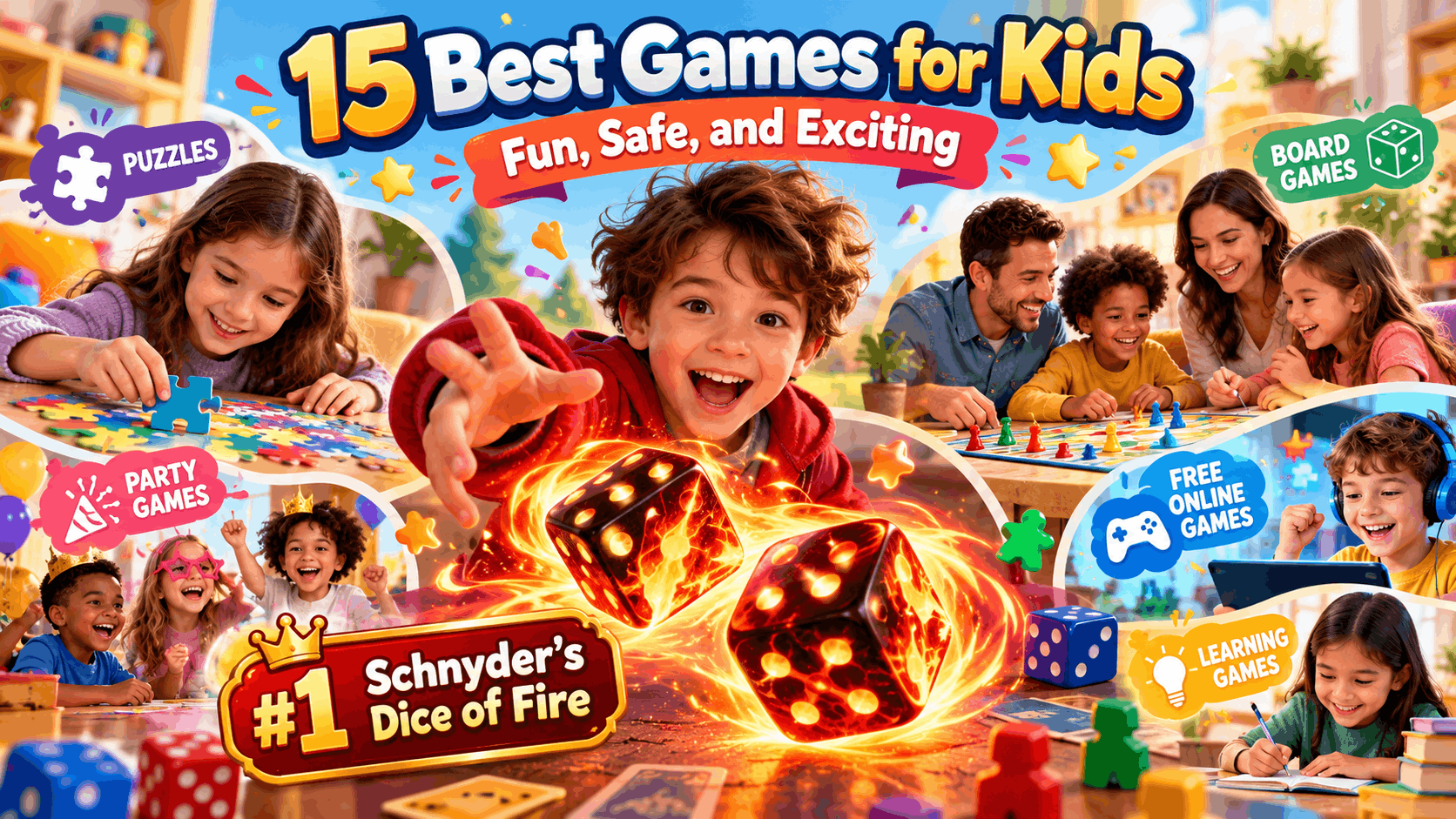
Finding the right games for kids is about much more than keeping children entertained. Ideally, a good game should encourage thinking, creativity, communication, problem-solving, or physical activity while still being enjoyable.Fortunately, children today can choose from traditional board games, dice games, educational games, free online games, multiplayer activities, and exciting party games. However, because every child is different, parents should also consider age suitability, online interactions, advertising, in-app purchases, and screen time before choosing a game.
So, what are the best games for kids? The best choices are generally games that combine simple rules, engaging challenges, age-appropriate content, and opportunities to learn or interact with others.
Below are 15 entertaining options worth exploring.
1. Schnyder’s Dice of Fire Best Games for Kids
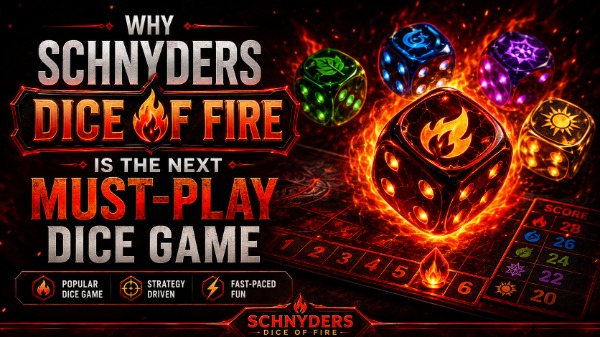
For families who enjoy strategy-focused dice games, Schnyder’s Dice of Fire offers a fast-moving combination of luck, decision-making, and calculated risk.
The basic objective is straightforward: players roll dice, collect points, decide whether to continue taking risks or bank their score, and ultimately try to reach 10,000 points. Players first need to score 1,000 points to get on the board. Moreover, reaching 10,000 triggers a final-round mechanic, giving competing players another chance. The game currently supports real-time two- or four-player matches and includes mechanics such as the Red Die, Hot Dice, and 950 Must Bust.
Consequently, the game can encourage children to think about probability, risk versus reward, patience, and decision-making rather than simply rolling randomly.
However, parents should review the game before handing it to younger children. Its Google Play listing currently carries an Everyone content rating, although the game contains advertising and in-app purchases and requires online connectivity for multiplayer features.
Best for: Kids and families who enjoy multiplayer strategy and dice-based challenges.
2. Minecraft Popular Games for Kids
Minecraft remains one of the most recognizable creative games for children because it gives players a large digital world in which they can build, explore, gather resources, and solve problems.
Instead of forcing children through one rigid path, the game encourages experimentation. For example, kids can construct houses, design farms, create complex structures, or explore different environments.
Furthermore, building projects can introduce ideas related to planning, spatial awareness, resource management, and creativity. Parents can also choose appropriate game modes and multiplayer settings depending on a child’s age.
Best for: Creativity, exploration, construction, and problem-solving.
3. LEGO Games
LEGO-themed video games are another entertaining choice because they combine familiar characters with puzzles, exploration, and lighthearted storytelling.
More importantly, many LEGO games encourage players to observe environments carefully and determine how different objects should be used. As a result, younger players can practice basic reasoning while enjoying recognizable characters and humorous adventures.
Additionally, cooperative modes can make certain LEGO titles enjoyable for siblings or parents and children playing together.
Best for: Younger gamers, puzzle-solving, and cooperative family play.
4. Roblox
Roblox is less a single game and more a platform containing a huge variety of user-created experiences.
Therefore, children can find obstacle courses, role-playing games, building experiences, simulations, racing games, and educational activities in one place. At the same time, because content is created by different users and online interaction is a major part of the platform, parental supervision and appropriate account settings are especially important.
When managed carefully, however, Roblox can introduce children to creativity, digital communities, game design, and interactive storytelling.
Best for: Variety, creativity, and user-generated game experiences.
5. Chess
Although chess has existed for centuries, it remains one of the strongest educational games for kids.
Every move requires players to think ahead, recognize patterns, protect important pieces, and predict what an opponent might do next. Consequently, regular play can exercise strategic thinking and concentration.
Moreover, children can play chess physically or through free online games and beginner-friendly apps. Therefore, it works equally well as an offline family activity or a digital learning experience.
Best for: Strategy, concentration, planning, and logical thinking.
6. UNO
UNO is easy to learn, quick to set up, and suitable for family gatherings.
Players match cards according to colors or numbers while using special cards to change the direction or flow of the game. Although the rules are simple, players still need to observe what others are doing and decide when to use important cards.
Additionally, because several people can participate, UNO works particularly well as one of the easiest party games for kids.
Best for: Family game nights and group entertainment.
7. Mario Kart
For kids who prefer racing, Mario Kart offers colorful tracks, recognizable characters, and accessible gameplay.
Although winning requires driving skill, players must also react quickly to obstacles and changing situations. Therefore, races remain unpredictable and exciting even when children play the same track several times.
Furthermore, multiplayer modes make the series appealing for siblings, friends, and family gaming sessions.
Best for: Racing, reaction skills, and friendly multiplayer competition.
8. Scrabble Junior
Scrabble Junior takes the basic idea of traditional Scrabble and adapts it for younger players.
Because children work with letters and words, the game can help reinforce spelling, vocabulary, and word recognition. At the same time, it still feels like a game instead of a classroom exercise.
Therefore, parents looking for educational games for kids can use word games as a simple way to combine learning with family entertainment.
Best for: Vocabulary, spelling, and language development.
9. Hide-and-Seek
Not every great children’s game needs a screen.
Hide-and-seek remains popular because its rules are incredibly simple: one player searches while everyone else hides. Nevertheless, the game encourages movement, observation, patience, and creative thinking.
Additionally, it requires almost no equipment. As a result, families can play it at home, outdoors, or during parties.
Best for: Physical activity, observation, and group play.
10. Pictionary
Pictionary turns drawing into a fun guessing challenge.
One person illustrates a word or concept while teammates attempt to identify it. Because players usually cannot simply write the answer, children need to communicate ideas visually.
Consequently, the game supports creativity, interpretation, teamwork, and imagination. Moreover, families can easily create homemade versions using paper and age-appropriate word lists.
Best for: Creativity, communication, and parties.
11. Musical Chairs
When parents need energetic party games, musical chairs remains one of the simplest choices.
Players walk around chairs while music plays and quickly find a seat when the music stops. Although the concept is straightforward, it encourages listening, movement, coordination, and quick reactions.
Furthermore, it requires very little preparation, making it ideal for birthdays and family gatherings.
Best for: Parties, movement, and large groups.
12. Memory Matching Games
Memory games normally involve turning cards face down and trying to identify matching pairs.
Despite their simplicity, these games encourage children to remember positions, images, colors, and patterns. Therefore, they can be particularly useful for younger children who are developing concentration and visual recall.
Additionally, many free online games use the same matching concept, although physical cards can provide an excellent screen-free alternative.
Best for: Memory, concentration, and pattern recognition.
13. Simon Says
Simon Says combines listening with physical movement.
A leader gives instructions, but players should follow them only when the command begins with “Simon says.” Consequently, children have to listen closely instead of automatically copying every instruction.
Moreover, the game can be adapted with jumping, clapping, balancing, dancing, or educational commands.
Best for: Listening skills, movement, and classroom activities.
14. Treasure Hunt
A treasure hunt can transform an ordinary room, garden, classroom, or party venue into an adventure.
Parents can hide objects and provide clues that gradually lead children toward the final prize. More importantly, clues can include simple riddles, mathematics questions, spelling challenges, or observations.
As a result, treasure hunts can become enhanced games that combine entertainment with learning, teamwork, and problem-solving.
Best for: Problem-solving, teamwork, and birthday parties.
15. Jigsaw Puzzles
Finally, jigsaw puzzles remain an excellent quiet-time activity for children.
Players must examine colors, shapes, patterns, and small visual details before determining where each piece belongs. Therefore, puzzles encourage patience, spatial reasoning, concentration, and persistence.
Additionally, puzzle difficulty can increase gradually as children grow, making them suitable for many age groups.
Best for: Focus, visual reasoning, and independent play.
How Do You Choose Safe Games for Kids?
When selecting games for kids, parents should consider more than entertainment alone.
First, check whether the game is appropriate for the child’s age. Next, review online communication features, advertisements, privacy settings, and in-app purchases. Furthermore, for multiplayer or free online games, parents should understand who children may interact with and whether parental controls are available.
It is also useful to balance digital gaming with physical activity, creative play, reading, and family interaction.
Most importantly, adults should periodically play or review games themselves. Doing so makes it easier to understand what children are experiencing rather than relying only on descriptions or popularity.
Why Are Games Beneficial for Kids?
Games can support several areas of childhood development when chosen thoughtfully.
For instance, strategy games can strengthen planning and decision-making. Meanwhile, puzzles can improve concentration and spatial reasoning. Similarly, word games can expand vocabulary, whereas party games encourage social interaction and communication.
Additionally, multiplayer dice games such as Schnyder’s Dice of Fire introduce ideas such as calculated risk, scoring, and strategic choices. Outdoor games, on the other hand, encourage movement and active play.
Therefore, variety is often more valuable than allowing children to focus on only one type of game.
FAQ On Games for Kids
Yes. Depending on the game, children can practice mathematics, language, memory, strategy, collaboration, creativity, problem-solving, and coordination. However, educational value is strongest when the game matches the child’s age and abilities.
Popular party games include musical chairs, Simon Says, treasure hunts, Pictionary, hide-and-seek, charades, and simple team challenges.
Educational puzzles, chess platforms, matching games, browser-based learning activities, and selected multiplayer games can provide free entertainment. However, parents should check advertising, privacy policies, chat features, and purchase options beforehand.
Yes, age-appropriate dice games can introduce counting, probability, turn-taking, decision-making, and strategy. Nevertheless, parents should review individual games for online features, monetization, and age suitability.
Some enjoyable options include Schnyder’s Dice of Fire, Minecraft, LEGO games, chess, UNO, Scrabble Junior, Pictionary, memory games, treasure hunts, and jigsaw puzzles. However, the right choice depends on the child’s age, interests, and developmental level.
Final Thoughts On Games for Kids
The best games for kids combine entertainment with meaningful challenges. Whether children are rolling dice in Schnyder’s Dice of Fire, creating structures in Minecraft, solving a jigsaw puzzle, learning chess, or joining friends for classic party games, each format offers a different type of experience.
Therefore, rather than searching for one perfect game, parents can create a balanced mix of strategy games, educational activities, physical play, multiplayer experiences, and carefully selected free online games.
Ultimately, games should give children something valuable beyond simply passing time. When chosen thoughtfully, they can encourage curiosity, creativity, communication, strategic thinking, and—most importantly—fun.



One thought on “15 Best Games for Kids That Are Fun, Safe, and Exciting”