


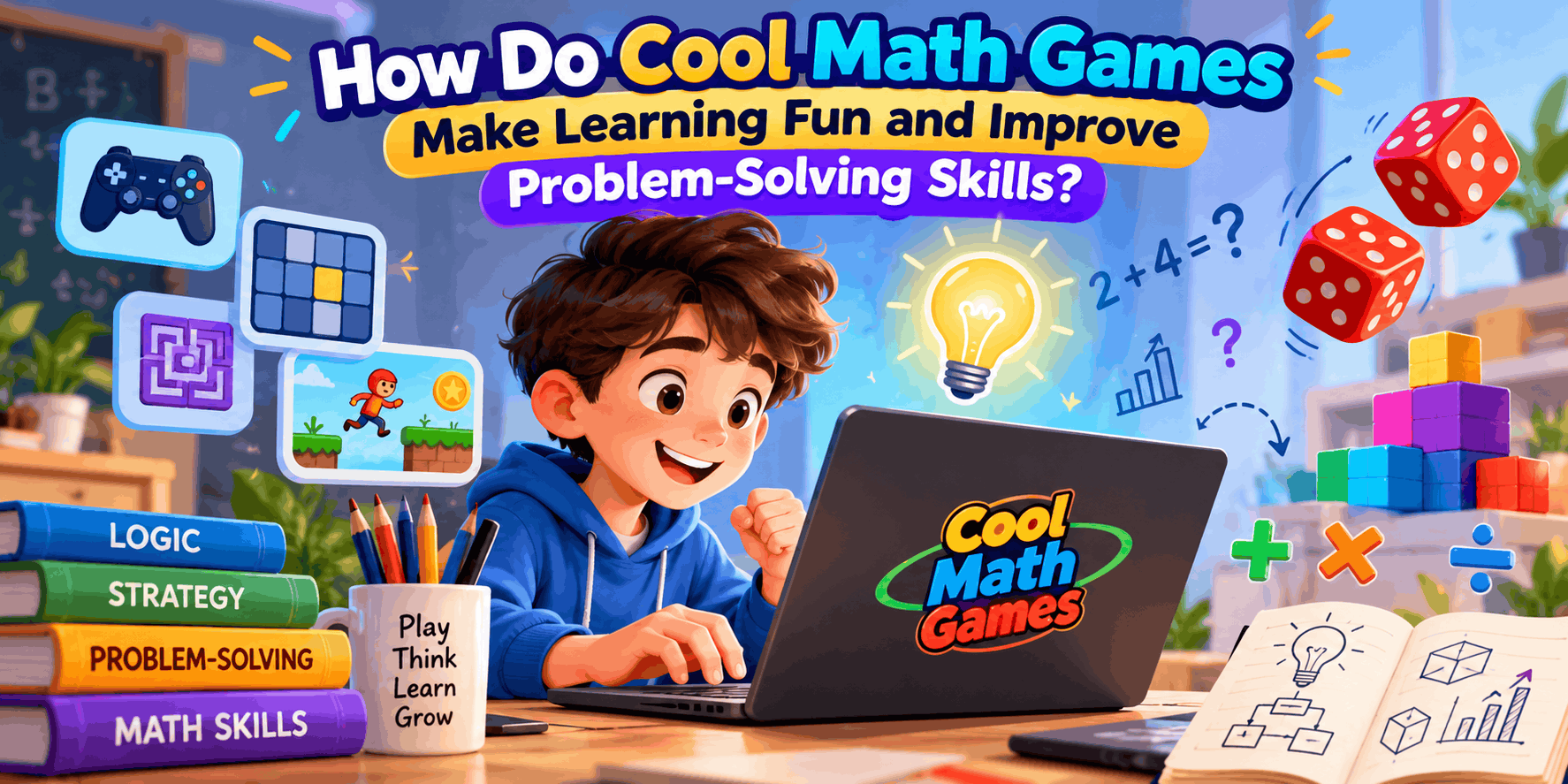
Learning mathematics doesn’t have to involve endless calculations, complicated formulas, or stressful classroom exercises. In fact, interactive games can transform mathematical challenges into enjoyable experiences. That’s where Cool Math Games comes in, offering entertaining activities that encourage players to think logically, make decisions, and develop problem-solving skills.
Moreover, as digital learning continues to evolve, educational games are becoming useful tools for students, teachers, and even adults. Instead of simply memorizing information, players can explore mathematical concepts through puzzles, strategy challenges, and interactive activities.
Whether you enjoy logic puzzles, number games, or dice games, understanding how educational gaming works can help you make better use of your playing time.
What Are Cool Math Games and How Do They Work?
Cool Math Games are interactive online games that encourage logical thinking, strategic planning, and problem-solving through entertaining challenges. Rather than focusing exclusively on traditional mathematics exercises, these games combine engaging gameplay with mental activities that require careful decisions.
The Coolmath Games platform has operated since 1997 and features games designed around reasoning, strategy, and decision-making.
For example, some games challenge players to solve number puzzles, while others involve navigating obstacles, managing resources, or identifying patterns.
Additionally, many games introduce progressively difficult levels. Consequently, players must adjust their strategies as challenges become more complex.
Most importantly, these activities demonstrate that learning can happen through exploration rather than repetitive instruction alone.
Why Do Cool Math Games Make Learning More Enjoyable?
Traditional learning methods sometimes make mathematics feel intimidating, particularly when students struggle with unfamiliar concepts. However, interactive games can create a more welcoming environment.
1. Learning Through Interactive Challenges
First, educational games encourage active participation. Instead of watching someone demonstrate a solution, players must experiment with different approaches.
For instance, a puzzle might require arranging numbers in a specific sequence. As players test possibilities, they begin recognizing relationships between numbers.
Therefore, the activity becomes both entertaining and intellectually engaging.
2. Encouraging Learning Through Mistakes
Furthermore, games often allow players to retry challenges after making incorrect decisions.
Rather than treating every mistake as a failure, players can examine what happened and attempt a different strategy.
As a result, gameplay creates opportunities to practice persistence and flexible thinking.
3. Making Difficult Concepts Easier to Explore
Similarly, visual puzzles and interactive activities can make abstract ideas more approachable.
For example, moving objects across a grid may introduce spatial reasoning, while balancing resources can encourage numerical comparison.
Consequently, players experience certain mathematical ideas through practical situations.
How Do Cool Math Games Improve Problem-Solving Skills?
Problem-solving involves understanding a challenge, identifying possible solutions, testing approaches, and evaluating results.
Interestingly, many educational games follow this same process.
Developing Logical Thinking
To begin with, logic-based games encourage players to examine clues and recognize patterns.
For example, a player solving a number puzzle must determine which values belong in particular positions.
Instead of guessing randomly, successful players usually benefit from comparing possibilities and eliminating incorrect choices.
Over time, repeated practice can help players become more familiar with structured reasoning.
Strengthening Strategic Planning
Additionally, strategy games encourage players to think beyond their immediate actions.
A decision that seems beneficial now might create difficulties later. Therefore, players must consider possible consequences before acting.
This type of planning is relevant to everyday situations, including organizing tasks, managing resources, and comparing alternatives.
Encouraging Creative Solutions
Likewise, some puzzles offer multiple possible approaches.
When an initial strategy fails, players may need to reconsider the problem from another perspective.
As a result, these activities can provide valuable practice in adaptability and creative problem-solving.
Research also supports the potential educational value of game-based learning. A 2026 meta-analysis found generally positive, although variable, effects on mathematics-related learning outcomes, including problem-solving.
What Types of Cool Math Games Support Learning?
Different games encourage different cognitive skills. Therefore, choosing activities that match your learning goals is important.
| Game category | Skills players can practice |
|---|---|
| Number puzzles | Arithmetic and numerical reasoning |
| Logic games | Deductive thinking and pattern recognition |
| Strategy games | Planning and decision-making |
| Memory games | Recall and concentration |
| Dice games | Probability, addition, and risk assessment |
| Spatial puzzles | Visual reasoning and problem-solving |
For instance, number-based games may help students practice basic calculations. Meanwhile, strategy puzzles can introduce more complex decision-making.
However, not every entertaining game teaches mathematics directly. Its educational value depends on the challenges involved and how players engage with them.
How Can Dice Games Improve Mathematical Thinking?
Dice games provide an accessible way to explore mathematical concepts while enjoying competitive or cooperative gameplay.
Although rolling dice involves chance, many dice games also require calculations, probability awareness, and strategic decisions.
Understanding Probability
First, dice games introduce players to the concept of probability.
For example, a standard six-sided die has six equally likely outcomes. Therefore, the probability of rolling a particular number is one in six.
Through repeated play, learners can begin understanding how probability describes uncertainty.
Practicing Mental Arithmetic
Furthermore, games involving multiple dice often require players to calculate totals quickly.
For instance, rolling a four and a five produces a total of nine.
Although this calculation is simple, repeated practice can reinforce basic addition skills.
Learning Risk Management
Additionally, some strategic dice games require players to decide whether to continue rolling or protect their existing score.
Consequently, players must compare potential rewards against possible losses.
These decisions introduce concepts related to risk assessment, probability, and strategic planning.
Why Are Educational Games Popular Among Players Today?
Among the many online games available today, educational and logic-based activities offer an appealing combination of entertainment and mental engagement.
Moreover, short gameplay sessions make them convenient for students looking for a break between study periods.
Furthermore, many games provide immediate feedback, helping players recognize whether their chosen approach works.
Nevertheless, popularity alone does not establish educational effectiveness. For meaningful learning, players should choose suitable challenges and reflect on the skills they practice.
Can Cool Math Games Help Students Perform Better in Mathematics?
Educational games can support mathematics learning, particularly when they reinforce classroom lessons and match students’ abilities. However, they should complement rather than completely replace structured instruction.
A 2025 meta-analysis examining mathematical higher-order thinking skills reported a small positive effect from game-based learning.
ScienceDirect
Similarly, a 2026 review found positive effects on mathematics learning outcomes, while emphasizing that game selection, student age, and teaching methods influence results.
International Journal of Instruction
Therefore, students may benefit most when games are combined with explanations, guided practice, and opportunities to apply what they learn.
For example, after playing a probability game, a teacher might ask students to calculate the likelihood of different outcomes.
This connection between gameplay and formal learning can make mathematical concepts more meaningful.
How Can Parents and Teachers Use Cool Math Games Effectively?
Although educational games are enjoyable, thoughtful guidance can improve their learning value.
First, parents and teachers should select age-appropriate activities that match the learner’s current abilities.
Next, they can establish reasonable gaming sessions that leave sufficient time for schoolwork, physical activity, and other responsibilities.
Additionally, discussing gameplay afterward can encourage deeper understanding.
For example, asking, “Why did you choose that strategy?” helps learners explain their reasoning.
Likewise, asking, “What would you do differently next time?” encourages reflection.
Most importantly, adults should focus on learning progress rather than simply achieving high scores.
Frequently Asked Questions About Cool Math Games
Regular gameplay can reinforce selected mathematical skills. However, students generally benefit more when educational games are combined with lessons, explanations, and structured practice.
A. Dice games involve mathematical ideas such as probability, addition, numerical patterns, and risk assessment. Therefore, they can provide practical examples of mathematical reasoning.
A. Yes. Many logic puzzles, strategy challenges, and number games can appeal to adults as well as younger players. Additionally, players can choose activities based on their interests and skill levels.
A. Yes, certain games can provide opportunities to practice critical thinking through puzzles, strategic decisions, and evaluating possible solutions. Nevertheless, improvements depend on the game and how it is used.
A. Cool Math Games combines entertainment with activities involving logic, strategy, and decision-making. However, individual games vary in how directly they teach mathematical concepts.
Conclusion
Cool Math Games demonstrates how entertainment and learning can work together to create engaging experiences. Through logic puzzles, strategy challenges, number activities, and dice games, players can practice reasoning, decision-making, and problem-solving in enjoyable ways.
Furthermore, educational games can encourage curiosity, persistence, and experimentation. However, their benefits depend on thoughtful game selection and meaningful engagement.
Ultimately, the most valuable learning experiences happen when players do more than complete levels. By understanding their decisions, exploring alternative solutions, and applying mathematical concepts beyond the screen, they can turn enjoyable gameplay into opportunities for intellectual growth.







One thought on “How Do Cool Math Games Make Learning Fun and Improve Problem-Solving Skills?”
Comments are closed.