


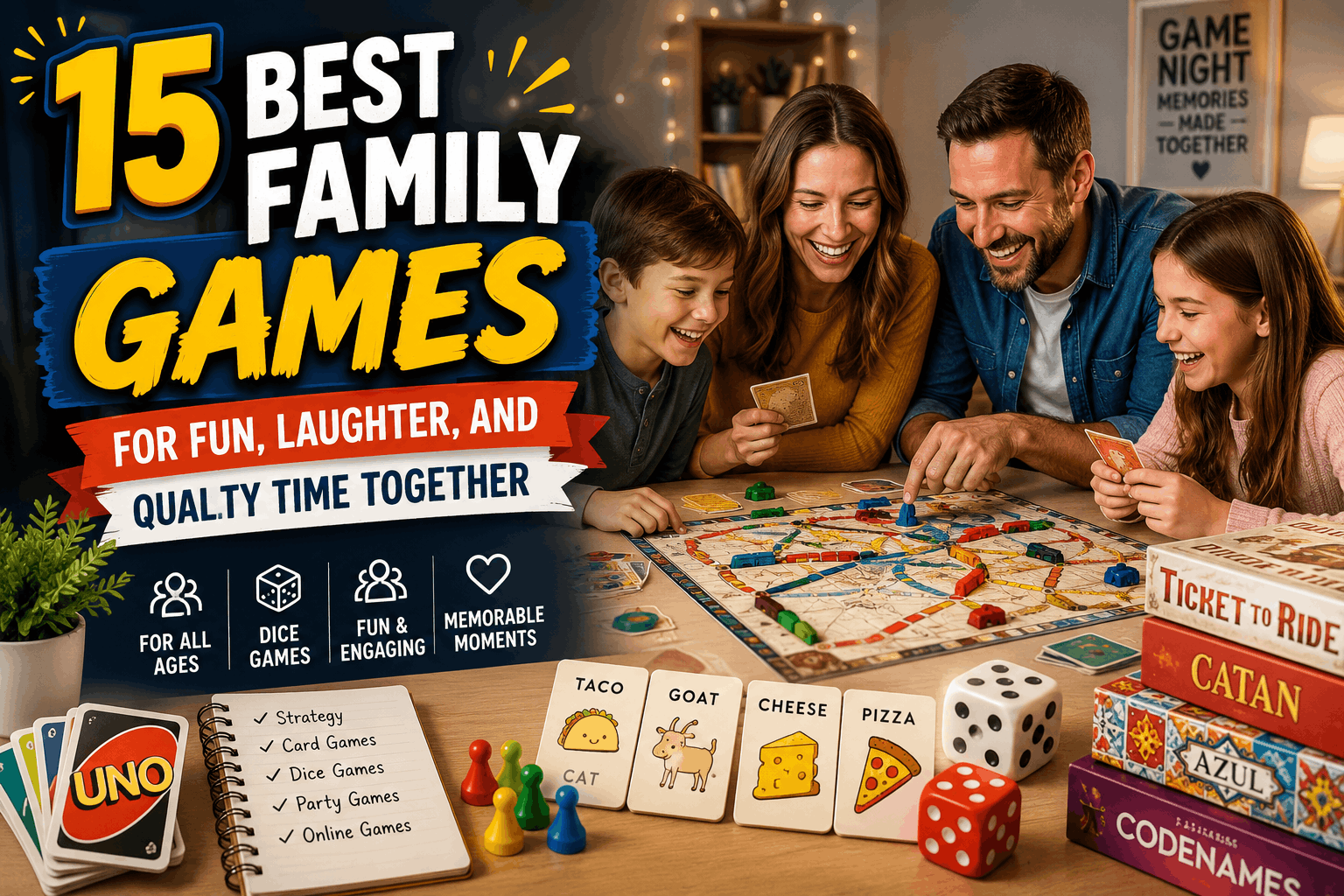
Finding the best family games is about more than choosing something to fill an evening. The right game can bring children, parents, grandparents, siblings, and friends around the same table, encourage conversation, create friendly competition, and turn an ordinary night at home into something everyone remembers.
That matters even more when entertainment is increasingly screen-based. Although watching a movie together can certainly be enjoyable, games ask everyone to participate. Players make decisions, react to one another, solve problems, take chances, and, most importantly, interact.
Fortunately, modern family games offer far more variety than many people realize. Families can choose from strategy board games, card games, cooperative adventures, word challenges, dice games, party games, and even online free games when everyone cannot be in the same room.
So, which games deserve a place at your next family game night?
Below are 15 of the best games for families, followed by practical advice for choosing games that fit your family’s ages, interests, group size, and preferred style of play.
What Makes a Great Family Game?
Before choosing a game, it helps to understand what separates a genuinely enjoyable family game from one that gets played once and then disappears into a closet.
Simple Rules
First, good family games should not require an hour-long explanation.
Ideally, new players should understand the basic objective quickly. Nevertheless, simple rules do not necessarily mean shallow gameplay. Some of the most replayable games use a small number of rules while creating many possible decisions.
Broad Age Appeal
Secondly, the best family games for all ages give younger and older players meaningful ways to participate.
Of course, a game designed for teenagers may not work for preschoolers. Therefore, families should always check the recommended age and consider the individual abilities of their players.
Strong Replay Value
A great family game should also feel different from one session to another.
Randomized cards, dice rolls, changing boards, player decisions, different teams, and alternative strategies can all improve replayability. Consequently, families are more likely to return to the game rather than treating it as a one-time activity.
Interaction
Most importantly, family games should encourage people to engage with one another.
That interaction might involve cooperation, negotiation, guessing, trading, storytelling, teamwork, or friendly competition. As a result, players become part of the entertainment instead of simply consuming it.
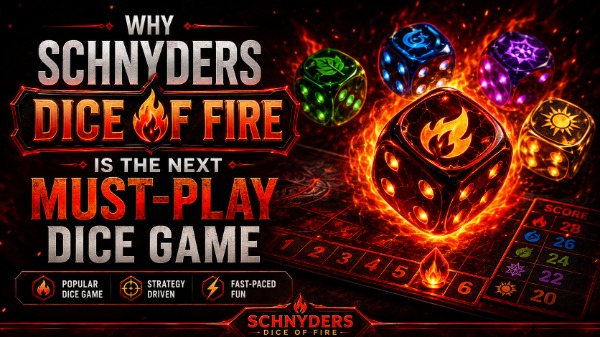
Schnyders Dice of Fire — Exciting Family Dice Strategy Game
Best for: Families and groups who enjoy luck, strategy, and competitive gameplay
Players: Multiplayer
Game style: Dice rolling, strategy, risk, and decision-making
Schnyders Dice of Fire brings together the unpredictability of dice rolling with strategic choices, creating a lively tabletop experience for families and groups.
Players roll the dice and make decisions based on the results, balancing the temptation to push for a stronger outcome against the risk of losing their progress. This combination of chance and decision-making helps keep each round unpredictable while giving players meaningful choices throughout the game.
What makes Schnyders Dice of Fire particularly appealing for family game nights is its energetic style of play. The dice-based mechanics can make the game approachable for casual players, while the strategic and risk-taking elements give players reasons to rethink their approach from one game to the next.
Because dice can quickly change the direction of play, no two sessions need to unfold exactly the same way. That unpredictability can create memorable moments, friendly competition, and plenty of opportunities for players to test how far they are willing to push their luck.
Why families may enjoy it:
- Easy-to-understand dice-based gameplay
- Mix of luck and strategic decision-making
- Exciting risk-versus-reward moments
- Encourages friendly competition
- Strong potential for replayability
- Suitable for social and family game nights
2. UNO — Best Classic Card Game for Families
Best for: Quick, casual family game nights
Game style: Matching card game
Few fun family games are as recognizable as UNO.
The objective is simple: players try to get rid of their cards by matching colors or numbers while action cards can change the direction of play, skip turns, or force opponents to draw additional cards.
Because turns are generally quick, players stay involved. Furthermore, the unpredictable nature of action cards can turn an apparently certain victory into a dramatic comeback.
UNO is especially useful when you want a game that requires minimal setup. In addition, its portable format makes it convenient for vacations, gatherings, and travel.
3. Yahtzee — Best Classic Family Dice Game
Best for: Families who enjoy probability and luck
Game style: Dice rolling and scoring
For anyone searching specifically for dice games, Yahtzee deserves consideration.
Players roll five dice and attempt to create scoring combinations. Depending on the rules, they can typically reroll selected dice while keeping others. Consequently, every turn creates a simple but meaningful question: should you accept a safe scoring opportunity or take another chance for something better?
That mixture of probability, luck, and decision-making makes traditional dice games particularly approachable.
Modern family-game recommendations still include Yahtzee because of its easy-to-understand dice mechanics and broad accessibility.
Additionally, digital versions of classic dice concepts have made online dice games increasingly convenient for people who want quick gameplay without setting up physical components.
4. Codenames — Best Family Word Game for Teams
Best for: Larger families and team play
Game style: Word association and deduction
Codenames transforms simple words into a clever communication challenge.
Players divide into teams, while clue-givers attempt to connect multiple words using a carefully chosen clue. Their teammates then have to determine which words the clue refers to.
As a result, the game encourages vocabulary, interpretation, creative thinking, and communication.
More importantly, many of the funniest moments come from discovering how differently relatives interpret the same clue.
For families with older children, teenagers, and adults, Codenames can therefore become an excellent choice for gatherings where team interaction matters more than complex strategy.
5. Azul — Best Family Game for Visual Strategy
Best for: Families who enjoy patterns and tactical decisions
Game style: Tile drafting and pattern building
Azul demonstrates that a strategy game does not need a complicated theme to remain engaging.
Players select decorative tiles and arrange them to complete patterns. However, each decision affects not only your own board but also the options remaining for everyone else.
Therefore, Azul rewards observation and forward planning without requiring lengthy negotiation or complicated storytelling.
It is frequently included in recommendations for accessible modern family strategy games, particularly because its core actions are relatively easy to understand while its tactical depth grows with experience.
6. Catan — Best Family Game for Trading and Negotiation
Best for: Families who enjoy social strategy
Game style: Resource management and trading
Catan has introduced countless families to strategy board games.
Players gather resources, build roads and settlements, and trade with one another. Because the board and resource situation change from game to game, players continually need to adapt.
However, the most distinctive part of Catan is often negotiation.
You might desperately need one resource while another player controls exactly what you want. Consequently, conversation and deal-making become part of the strategy.
Current family-game recommendations still regularly feature Catan for households that enjoy deeper strategy and trading.
Nevertheless, younger players or families wanting very short sessions may prefer a lighter option.
7. Blokus — Best Family Game for Simple Strategic Thinking
Best for: Visual thinkers and younger strategists
Game style: Abstract strategy
Blokus proves how a very simple rule can produce surprisingly thoughtful gameplay.
Players place differently shaped pieces onto a shared board while following placement restrictions. As the board fills, available space becomes increasingly valuable.
Initially, the game seems simple. Soon, however, players realize they must think about positioning, future moves, and their opponents’ available space.
Therefore, Blokus can be particularly appealing for families that want strategy without extensive reading or complicated resource systems.
It also continues to appear among current family-game recommendations, including as a budget-friendly option.
8. Sushi Go Party! — Best Family Game for Larger Groups
Best for: Parties and bigger family gatherings
Game style: Card drafting
Sushi Go Party! combines colorful presentation with accessible card-drafting mechanics.
Players choose a card and then pass the remaining cards onward. Consequently, you have to think about what you want while also paying attention to what other players may be collecting.
The system is relatively simple, yet repeated games encourage better strategic decisions.
Furthermore, because everyone is involved at roughly the same time, downtime is limited.
Current family-game guides continue to recommend Sushi Go Party! for larger tables and accessible group play.
9. Forbidden Island — Best Cooperative Family Game
Best for: Families that prefer teamwork
Game style: Cooperative strategy
Not every family enjoys competing against one another.
Fortunately, cooperative games offer an alternative.
In Forbidden Island, players work together toward a shared objective while the game itself creates escalating challenges. Rather than trying to defeat another family member, everyone succeeds or fails together.
Consequently, players need to communicate, coordinate their abilities, and decide which problems require immediate attention.
This makes cooperative family games especially valuable for households where highly competitive games sometimes create frustration.
Forbidden Island remains a frequently recommended entry point into cooperative tabletop gaming.
10. Carcassonne — Best Tile-Laying Family Game
Best for: Families wanting strategy with simple turns
Game style: Tile placement
Carcassonne is built around a wonderfully intuitive action: draw a tile and add it to an expanding landscape.
Roads connect to roads, cities connect to cities, and the map gradually develops in a different way every time.
However, beneath that straightforward system is a strategic challenge involving placement, scoring opportunities, and limited resources.
Because the board effectively builds itself during play, each game creates a new puzzle. Therefore, Carcassonne has considerable replay value and can grow with players as their strategic skills improve.
It remains a recommended choice for families seeking accessible but rewarding strategy.
11. Taco Cat Goat Cheese Pizza — Best Fast-Paced Family Party Games
Best for: Laughter and short game sessions
Game style: Reflex and matching card game
Sometimes families do not want deep strategy. Instead, they want chaos, quick reactions, and laughter.
Taco Cat Goat Cheese Pizza fits that role particularly well.
Players follow a repeating verbal sequence while revealing cards. When the spoken word matches what appears, everyone must react quickly.
The concept is deliberately simple. Nevertheless, the combination of concentration and reflexes creates mistakes, surprises, and plenty of laughter.
Current family-game lists repeatedly highlight it as a quick, accessible choice, particularly for younger players and short sessions.
12. Pictionary — Best Creative Family Games
Best for: Creative families and mixed skill levels
Game style: Drawing and guessing
You do not have to be an artist to enjoy Pictionary. In fact, terrible drawings often create the funniest moments.
Players attempt to communicate words or phrases through pictures while teammates race to guess the answer.
Therefore, the game encourages creative communication without requiring artistic talent.
It also gives families a refreshing alternative to games focused primarily on mathematics, memorization, or strategy.
Even better, families can create a homemade version using paper, pencils, a timer, and a list of words.
13. Charades — Best No-Cost Family Games
Best for: Parties, holidays, and spontaneous game nights
Cost: Free
Game style: Acting and guessing
You do not actually need to buy anything to have an excellent family game night.
Charades requires little more than ideas and willing participants.
Players act out a word, character, object, title, or action without speaking while everyone else tries to identify it.
Moreover, families can easily adjust categories to suit different ages. Younger children might act out animals or everyday objects, whereas adults and teenagers might prefer movies, famous characters, occupations, or challenging phrases.
As a result, charades is one of the most flexible family games for all ages.
14. Family Trivia — Best Educational Family Games
Best for: Learning while playing
Game style: Questions and knowledge
Trivia turns knowledge into friendly competition.
However, the best family trivia sessions use categories that give everyone an opportunity to contribute.
For example, you might combine:
- Animals
- Geography
- Science
- Sports
- Movies
- Music
- History
- Food
- Nature
- General knowledge
Furthermore, families can create age-adjusted questions so younger children are not competing directly against adults on identical material.
This makes trivia both entertaining and educational.
Players are exposed to new facts, while the discussion surrounding answers can encourage curiosity long after the question is finished.
15. Online Free Games — Best Family Games
Best for: Long-distance families and convenient digital play
Game style: Varies
Family game night no longer requires everyone to sit around one physical table.
Today, online free games can help relatives play together across different cities or even countries. Browser-based options can include memory games, word challenges, puzzles, trivia, card games, drawing games, and digital dice activities.
For example, browser family-game collections increasingly emphasize instant access, device flexibility, and little or no physical setup.
Likewise, online dice games can recreate familiar dice-rolling mechanics digitally, sometimes with automatic scoring and virtual dice.
However, parents should still review any online platform before younger children use it. In particular, check whether a game contains advertising, public chat, account requirements, in-app purchases, or links to outside content.
Therefore, digital games can complement traditional family game night rather than necessarily replacing tabletop games.
Why Dice Games Work So Well for Family Games
Among the many categories available, dice games have a special advantage: randomness makes every roll uncertain.
A younger player may roll brilliantly while an experienced adult gets unlucky. Consequently, skill differences do not always determine the outcome.
At the same time, well-designed dice games still give players decisions to make.
Should you reroll? or you keep the safe result?
Should you take another risk? or Should you change your strategy based on what you rolled?
That combination of chance and choice can make dice games exciting without making them intimidating.
Recent dice-game guides similarly emphasize the appeal of visible luck combined with strategic decisions and replayability.
Furthermore, families now have both traditional tabletop options and online dice games, giving them flexibility depending on where and how they want to play.
Physical Family Games vs. Online Family Games
Both formats have advantages.
Traditional board, card, and dice games encourage face-to-face interaction. Players physically handle components, watch one another’s reactions, and share the same environment.
Online games, meanwhile, offer convenience.
They can be particularly useful when:
- Family members live far apart
- You do not own many physical games
- You want something with almost no setup
- You are traveling
- You want a quick activity
- Everyone already has access to a phone, tablet, or computer
Therefore, the better choice depends on the situation.
For a weekly household game night, physical games may create a stronger shared-table experience. Conversely, for relatives separated by distance, online free games can provide an easy way to continue playing together.
How to Choose the Best Family Games for Your Family
With thousands of choices available, selecting the best Family Games games for families can initially feel overwhelming.
Fortunately, five questions can narrow the options quickly.
1. Who Is Playing?
Start with age and ability.
A game for adults and teenagers can include deeper strategy. Meanwhile, a game involving young children should generally use clearer rules, shorter turns, and accessible concepts.
2. How Many People Will Play?
Next, check player count.
Some games work brilliantly with two people but become impossible with eight. Conversely, party games may become more entertaining as the group grows.
3. How Much Time Do You Have?
Not every game night needs to last two hours.
For a school night, a 10-to-30-minute card or dice game might be ideal. On weekends, however, your family may enjoy a longer strategy experience.
4. Competitive or Cooperative?
This question can dramatically improve game selection.
If your family loves rivalry, choose competitive strategy, card, or dice games.
However, if competition regularly creates arguments, consider cooperative games where everyone works toward the same objective.
5. What Does Your Family Actually Enjoy?
Finally, do not choose a game simply because it is popular.
Instead, match the game to your family’s interests.
For example:
| Your Family Enjoys | Consider |
|---|---|
| Strategy | Ticket to Ride, Azul, Catan |
| Words | Codenames |
| Dice | Yahtzee and other family dice games |
| Teamwork | Forbidden Island |
| Creativity | Pictionary, Charades |
| Fast action | Taco Cat Goat Cheese Pizza |
| Learning | Family Trivia |
| Remote play | Online free games |
| Tile placement | Carcassonne, Azul |
| Large gatherings | Sushi Go Party!, Codenames |
How Family Games Can Support Learning
Entertainment and education do not have to be separate.
Depending on the game, children and adults may naturally practice useful skills while playing.
For instance, strategy games can encourage planning and decision-making. Word games may reinforce vocabulary and communication. Meanwhile, trivia can expose players to geography, science, history, culture, and general knowledge.
Likewise, dice games can introduce younger players to counting, probability, pattern recognition, and basic mental arithmetic.
Cooperative games add another dimension because players must communicate and coordinate their decisions.
Nevertheless, families do not need to turn every game into a lesson.
The educational value often works best when learning happens naturally through play rather than becoming the sole objective.
Tips for Creating a Better Family Game Night
Choosing the right Family Games is only half the equation. The atmosphere matters too.
First, select the game before everyone sits down. This prevents 20 minutes of debating what to play.
Next, learn the core rules beforehand whenever possible. WIRED’s family-game guide similarly recommends using instructional videos when a visual explanation is easier than reading rules aloud.
Additionally, keep the first session relaxed. New players will make mistakes, so avoid turning every rule misunderstanding into a major interruption.
You can also rotate who chooses the game each week. Consequently, children, teenagers, parents, and other relatives all get opportunities to introduce their favorites.
Finally, remember the actual objective of family game night.
Winning is enjoyable.
Wanting to play together again is better.
FAQ About the Best Family Games
The best family game is one that fits the people actually playing it. Generally, strong choices combine understandable rules, appropriate playing time, interaction, replayability, and meaningful participation for everyone.
Choose games with a small number of actions and quick turns. UNO, charades, Yahtzee, Blokus, Pictionary, and many simple party games can be easier entry points than heavier strategy games.
Yes. There are many online free games involving puzzles, memory, trivia, words, cards, drawing, and virtual dice. Nevertheless, “free” does not always mean completely free of advertisements, optional purchases, or account requirements, so check the platform beforehand.
Yes. Dice games are often family-friendly because rolling is easy to understand and introduces an element of chance. Furthermore, many dice games combine luck with probability, risk management, scoring, and strategic decision-making.
Popular fun family games include Ticket to Ride, Codenames, UNO, Yahtzee, Azul, Sushi Go Party!, Taco Cat Goat Cheese Pizza, Pictionary, Forbidden Island, and charades. The ideal choice depends on your group’s size, age range, and preferred level of strategy.
For families with children, prioritize short turns, clear objectives, colorful or tactile components, and limited reading requirements. Blokus, UNO, age-appropriate Ticket to Ride editions, simple dice games, charades, and drawing games are useful places to start.
Some of the strongest family games for all ages are those with simple core rules, limited downtime, and enough choice to remain interesting. Ticket to Ride, UNO, Blokus, Yahtzee, charades, Pictionary, and accessible trivia games can all work well, although parents should always consider the recommended age and abilities of individual players.
Final Thoughts: Make Family Game Night About Connection
Ultimately, the best family games are not necessarily the most expensive, complicated, or popular ones. They are the games that make people look forward to sitting down together again.
For some families, that could mean planning railway routes in Ticket to Ride. For others, it might involve negotiating in Catan, cooperating in Forbidden Island, drawing terrible pictures in Pictionary, testing knowledge with trivia, or waiting anxiously for the next roll in a favorite dice game.
Meanwhile, online free games and online dice games provide additional flexibility when relatives cannot gather physically.
The key is variety.
Try strategy one week and a party game the next. Mix competitive games with cooperative experiences. Furthermore, allow different family members to choose what gets played.





2 thoughts on “15 Best Family Games for Quality Time and Endless Fun”