

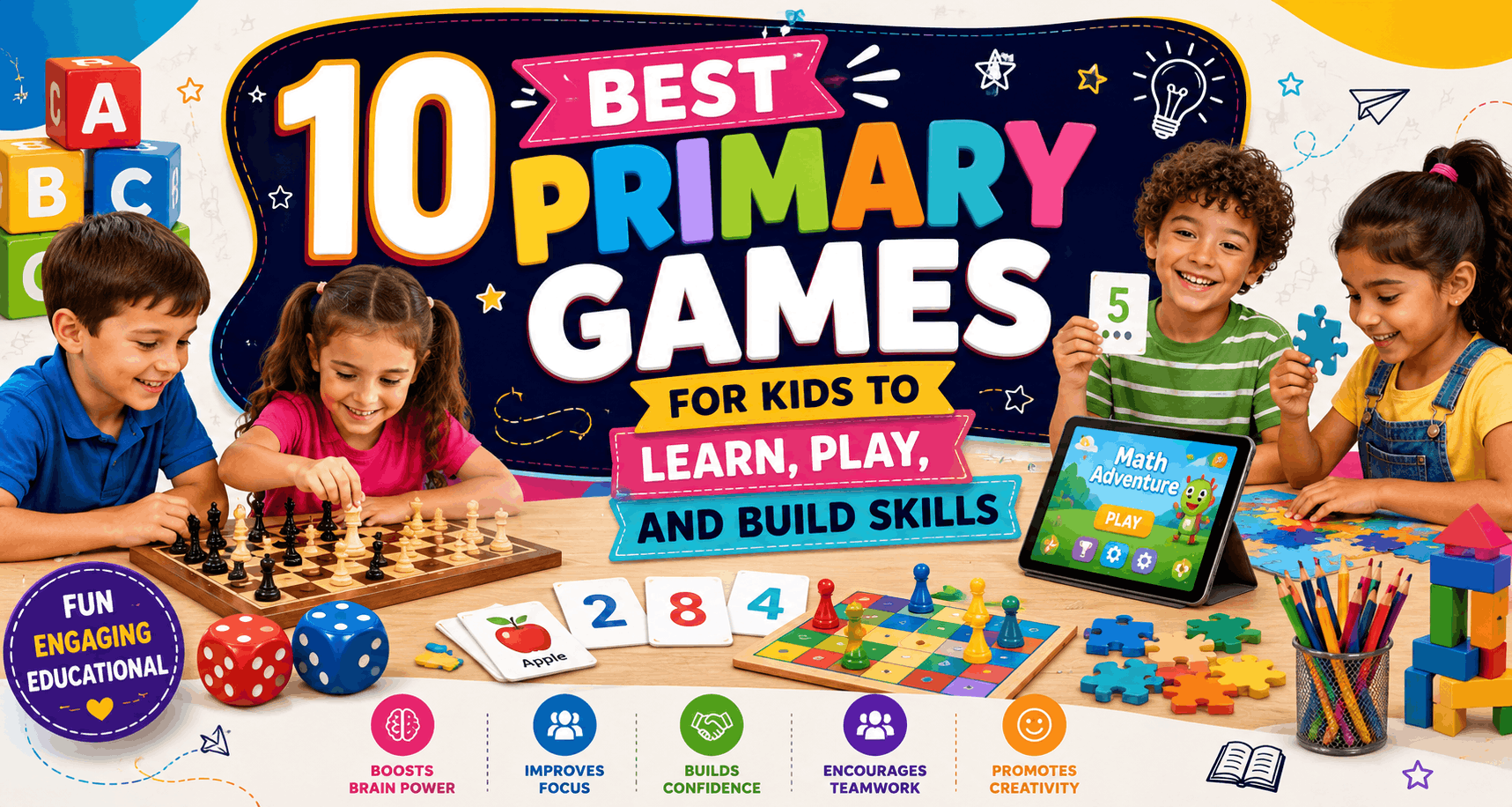
Learning does not always have to happen through worksheets, textbooks, or traditional lessons. In fact, some of the most memorable learning experiences happen when children are actively playing, experimenting, solving problems, and interacting with others.That is exactly why Primary Games can be so valuable.The best educational games for kids combine enjoyment with meaningful opportunities to practise mathematics, language, reasoning, creativity, communication, memory, and social skills. Moreover, games can give children an immediate reason to use what they know. Instead of simply memorising information, they make decisions, test strategies, notice patterns, and learn from outcomes.
Below are 10 of the best primary school games for combining learning, fun, and skill building at home or in the classroom.
What Are the Best Primary Games for Kids?
The best Primary Games are activities that give children an enjoyable challenge while practising useful academic, cognitive, social, or physical skills.
Ten excellent options are:
- Dice Math
- Word Bingo
- Memory Match
- Pictionary
- Simon Says
- Story Cubes
- Treasure Hunt
- Chess
- Math Relay
- Educational Online Games
Together, these learning games for children can support numeracy, literacy, memory, problem-solving, communication, creativity, coordination, teamwork, and strategic thinking.
Why Are Primary Games Important for Children?
Children learn through active participation. Therefore, games can complement conventional instruction by turning concepts into experiences.
For example, a child practising addition with dice receives a number problem instantly. Similarly, a child playing Pictionary has to understand a word, represent its meaning visually, and communicate that meaning to other players.
Furthermore, games naturally introduce repetition. Children may perform the same academic skill multiple times without experiencing it in exactly the same way each time.
Modern board-game research is particularly encouraging. A 2025 study involving 238 primary students and 17 teachers found that students perceived the games as enjoyable and educational, while teachers reported benefits involving motivation, collaboration, and cognitive and emotional skills.
Consequently, well-designed kids educational activities can help make practice more active and engaging.
1. Dice Math
Best for: Mathematics, number recognition, mental arithmetic, probability
Recommended ages: 5–11
Players: 2 or more
Materials: Two or more dice
Dice Math is one of the easiest Dice games to adapt for different primary-school ages.
To begin, each player rolls two dice. Younger children can add the numbers together. Older children, however, can use the rolled numbers for subtraction, multiplication, comparison, or creating simple equations.
For example, if a child rolls 4 and 6, the challenge might be:
4 + 6 = 10
Alternatively, older learners could calculate:
4 × 6 = 24
Teachers can increase the difficulty by adding a third die or asking students to create the largest possible number.
Therefore, one inexpensive activity can support several stages of mathematical development.
Importantly, research has also investigated dice-based mathematics instruction. One study of primary students found that a dice-game-based teaching approach produced significantly better multiplication learning outcomes than conventional instruction in the study population.
Skills developed: counting, arithmetic fluency, number sense, decision-making, mental calculation, and mathematical confidence.
2. Word Bingo
Best for: Vocabulary, spelling, reading, listening
Recommended ages: 5–10
Players: Small groups or an entire class
Word Bingo transforms familiar bingo rules into a literacy activity.
Instead of numbers, each square contains a word. The teacher or parent can then call definitions, synonyms, sounds, pictures, or clues rather than simply reading the answer aloud.
For instance, if the target word is “enormous,” the clue could be “another word for very big.”
As a result, children have to understand meaning instead of merely recognising sounds.
Additionally, Word Bingo can be adapted for phonics, sight words, science terminology, geography, foreign-language vocabulary, and spelling practice.
“Because the rules are simple and easy to adapt, Word Bingo is one of the most versatile classroom games for kids.”
Skills developed: vocabulary, listening comprehension, reading fluency, word recognition, spelling, and concentration.
3. Memory Match
Best for: Memory, concentration, visual recognition
Recommended ages: 4–10
Players: 1–4
Memory Match is simple, yet it requires sustained attention.
Place matching pairs of cards face down. Players turn over two cards during each turn. If the cards match, the player keeps the pair. Otherwise, both cards are turned face down again.
However, educational versions can go much further.
For example, teachers can create matching pairs using:
- words and definitions;
- countries and capitals;
- numbers and number words;
- animals and habitats;
- multiplication questions and answers;
- shapes and their names.
Consequently, the game becomes both a memory challenge and a curriculum-reinforcement activity.
Most importantly, children must remember not only what they saw but also where they saw it. Therefore, Memory Match works particularly well as one of many brain games for children.
Skills developed: working memory, attention, visual processing, concentration, and recall.
4. Pictionary
Best for: Vocabulary, creativity, communication
Recommended ages: 6–11
Players: 4 or more
Pictionary shows that fun learning activities can be simple, engaging, and effective without relying on expensive technology.
One player receives a word and attempts to draw it without writing letters or saying the answer. Meanwhile, teammates try to identify the word.
Although the activity looks simple, several learning processes happen simultaneously.
First, the child must understand the concept. Next, they must decide which visual information communicates it effectively. Finally, the other players interpret those visual clues and connect them with existing vocabulary.
Teachers can also create themed rounds involving science, geography, history, verbs, occupations, animals, or classroom vocabulary.
Therefore, Pictionary combines creative expression with retrieval practice and communication.
Skills developed: vocabulary, visual communication, creativity, conceptual understanding, teamwork, and quick thinking.
5. Simon Says
Best for: Listening, attention, movement, self-control
Recommended ages: 4–8
Players: 3 or more
Not every educational activity needs to happen while children are sitting down.
Simon Says combines physical movement with careful listening. The leader gives instructions such as:
“Simon says touch your shoulders.”
Players should follow the instruction only when it begins with “Simon says.”
Although entertaining, the game requires children to listen carefully, remember a rule, inhibit an automatic response, and react appropriately.
Furthermore, teachers can incorporate academic concepts.
For example:
“Simon says make a triangle with your fingers.”
“Simon says jump five times.”
“Simon says point to something rectangular.”
Thus, movement can reinforce vocabulary, mathematics, body awareness, and classroom concepts.
Skills developed: listening, attention, coordination, self-regulation, following instructions, and body awareness.
6. Story Cubes
Best for: Storytelling, writing, imagination, speaking
Recommended ages: 6–11
Players: 1 or more
Story Cubes are excellent skill-building games for children who need encouragement with creative writing or verbal expression.
Instead of traditional numbered dice, story dice contain pictures or symbols. Children roll several dice and then create a story connecting the images.
Suppose the dice show a castle, a key, rain, and a bird. A child could invent a story about a bird carrying a magical key to a castle during a storm.
There is no single correct answer.
Consequently, children are encouraged to experiment with ideas rather than worrying immediately about being right or wrong.
The activity can also teach narrative structure. For example, children can organise their stories around a beginning, problem, solution, and ending.
Notably, research examining modern board games in primary education identified Rory’s Story Cubes as particularly useful for linguistic competence within the studied educational programme.
Skills developed: storytelling, imagination, vocabulary, sequencing, speaking, writing, and creative thinking.
7. Educational Treasure Hunt
Best for: Problem-solving, teamwork, reading comprehension
Recommended ages: 6–11
Players: Individuals or teams
A treasure hunt becomes an educational game when every clue requires children to solve a problem before reaching the next location.
For example:
“Find something in the room shaped like a rectangle.”
Or:
“I am thinking of a number. Multiply 4 by 3 to discover the clue number.”
Alternatively, a reading-focused hunt might require children to solve riddles.
Because every correct answer moves players toward a visible goal, learning becomes part of the adventure.
Additionally, treasure hunts encourage movement. Therefore, they are particularly useful when children need a break from desk-based tasks.
Teachers can build hunts around mathematics, vocabulary, science, geography, history, or general knowledge.
Skills developed: problem-solving, reading comprehension, teamwork, observation, reasoning, and physical activity.
8. Chess
Best for: Strategy, planning, logical thinking
Recommended ages: 6+
Players: 2
Chess is one of the classic brain games for children because every move creates consequences.
Players must consider where pieces can move, what their opponent might do next, and how short-term decisions affect longer-term goals.
As a result, chess creates repeated opportunities for strategic thinking.
Beginners do not need to learn every advanced concept immediately. Instead, children can begin by learning how individual pieces move. Afterward, they can practise simplified mini-games before progressing to full matches.
This gradual approach makes chess less intimidating.
Moreover, strategic games encourage children to evaluate alternatives rather than choosing the first possible action.
Skills developed: planning, patience, logical reasoning, pattern recognition, decision-making, concentration, and strategic thinking.
9. Math Relay
Best for: Arithmetic, teamwork, movement
Recommended ages: 6–11
Players: Teams
Math Relay combines academic practice with physical activity.
Divide children into teams and place mathematics questions at another point in the room. One player from each team moves to the question area, solves a problem, returns, and allows the next teammate to continue.
However, speed should never become more important than understanding.
Therefore, teachers can award points for accuracy, explanation, cooperation, or improvement rather than rewarding only the fastest team.
The activity can cover:
- addition;
- subtraction;
- multiplication;
- division;
- fractions;
- shapes;
- measurement;
- word problems.
As a result, the same game structure can be reused across multiple lessons.
Skills developed: arithmetic fluency, teamwork, communication, confidence, physical coordination, and quick recall.
10. Educational Online Games
Best for: Independent practice and interactive learning
Recommended ages: Varies by platform
Players: Usually individual
Digital learning can also play a useful role when online games have a clear educational purpose.
Quality free online games may allow children to practise mathematics, reading, science, logic, or problem-solving while receiving immediate feedback.
For instance, some educational platforms provide browser-based activities covering maths, reading, science, and logic for children across primary-age ranges.
Research into digital game-based learning has likewise reported promising results. A randomised controlled study involving 634 primary-school children found improvements in mental-computation accuracy and speed in both study groups, with gains in the game-console group reaching up to twice those of controls.
Nevertheless, digital games should be chosen thoughtfully.
Parents and teachers should consider whether a game:
- matches the child’s age;
- has a clear learning objective;
- gives understandable feedback;
- avoids unnecessary distractions;
- provides an appropriate challenge;
- protects children’s privacy;
- complements rather than replaces varied learning experiences.
Therefore, online games are most useful as one part of a broader mix of educational activities.
Skills developed: digital literacy, independent learning, subject practice, problem-solving, attention, and technology confidence.
How to Choose the Right Primary Games
The “best” educational game depends on what a child needs to practise.
For mathematics, consider Dice Math or Math Relay. Meanwhile, Word Bingo is better suited to vocabulary and reading. Story Cubes and Pictionary encourage creativity and communication, whereas Chess and Memory Match emphasise strategic thinking, concentration, and recall.
Parents and teachers should also consider difficulty.
If a game is too easy, children may lose interest. Conversely, if it is unnecessarily difficult, frustration can replace productive challenge.
Therefore, look for activities that stretch existing abilities while remaining achievable.
Most importantly, ask one question before choosing a game:
What should the child be able to practise while playing?
Starting with the learning objective makes it much easier to choose appropriate educational games for kids.
How Can Teachers Use Primary Games in the Classroom?
Games work best when they are connected to learning goals rather than added simply to fill time.
Before playing, teachers should explain the objective and rules clearly. During the activity, they can observe how children approach challenges. Afterward, a short reflection can turn gameplay into an even richer learning opportunity.
For example, teachers might ask:
“What strategy worked?”
“What was difficult?”
“How did your team solve the problem?”
“What would you do differently next time?”
These questions encourage children to think about their own learning process.
Furthermore, classroom games can be adapted for different ability levels. A Dice Math activity, for example, might involve addition for one group and multiplication for another. Consequently, the basic activity remains familiar while the learning challenge changes.
What Skills Can Children Build Through Primary Games?
Well-selected primary school games can support several areas of development simultaneously.
Cognitive skills
Puzzles, chess, memory activities, and mathematical games can encourage reasoning, attention, planning, pattern recognition, and problem-solving.
Academic skills
Word games reinforce literacy, while number-based games provide repeated mathematical practice. Similarly, subject-specific games can reinforce science, geography, history, and general knowledge.
Communication skills
Collaborative games require children to explain ideas, listen, negotiate, ask questions, and interpret other people’s instructions.
Social-emotional skills
Taking turns, following rules, coping with setbacks, and working toward shared goals can create useful opportunities to practise patience and cooperation.
Creative skills
Storytelling, drawing, role-playing, and open-ended challenges encourage children to generate and communicate original ideas.
Therefore, the educational value of a game often extends far beyond the most obvious subject it teaches.
Primary Games vs. Traditional Learning: Which Is Better?
It does not have to be one or the other.
Games are most valuable when they complement high-quality teaching, reading, discussion, practice, creative activities, and real-world experiences.
Traditional instruction can efficiently introduce concepts. Meanwhile, games can give children opportunities to apply, repeat, explore, and discuss those concepts.
Research into game-based learning has reported benefits across cognitive and educational outcomes, although results depend on the game, learning objective, implementation, age group, and study design.
Therefore, the goal should not be to replace every lesson with a game. Instead, educators can use games strategically when play provides a meaningful way to practise the desired skill.
Frequently Asked Questions About Primary Games
There is no universal duration that works for every child or activity. Instead, parents and teachers should consider the child’s age, attention, learning objective, type of game, and overall balance of activities. A shorter focused session can often be more productive than prolonged play after engagement has disappeared.
They can be useful when they are age-appropriate, focused on a clear learning objective, and selected carefully. However, digital play is best balanced with reading, physical activity, conversation, creative work, and offline games.
Chess, memory matching, puzzles, strategy games, number challenges, pattern-recognition activities, and logic games can all encourage children to think carefully and solve problems.
They can be. Dice games can reinforce counting, number recognition, addition, subtraction, multiplication, probability, and mental calculation. Research has also explored dice-based activities as a way of supporting multiplication learning among primary students.
Word Bingo, Pictionary, Dice Math, Memory Match, Simon Says, Math Relay, and educational treasure hunts are particularly adaptable because teachers can change the content without completely changing the rules.
Final Thoughts On Primary Games
The best Primary Games achieve something simple but powerful: children enjoy the activity while using skills that matter.
A roll of the dice can become a mathematics challenge. A drawing game can become vocabulary practice. A treasure hunt can develop reading and problem-solving. Meanwhile, chess can encourage planning, and Story Cubes can transform random images into creative language.
Therefore, learning games for children do not need to feel like disguised worksheets.
The strongest kids educational activities give children meaningful decisions, achievable challenges, useful feedback, and opportunities to participate actively. Furthermore, they allow parents and teachers to adjust difficulty as children’s abilities develop.
Ultimately, there is no single perfect educational game. The right choice depends on the learner and the skill being developed.
For numeracy, try Dice Math. For literacy, choose Word Bingo. For creativity, use Pictionary or Story Cubes. For reasoning, introduce Chess or Memory Match. For active group learning, try a Math Relay or Treasure Hunt. Finally, for independent practice, carefully selected free online games can provide another useful option.