

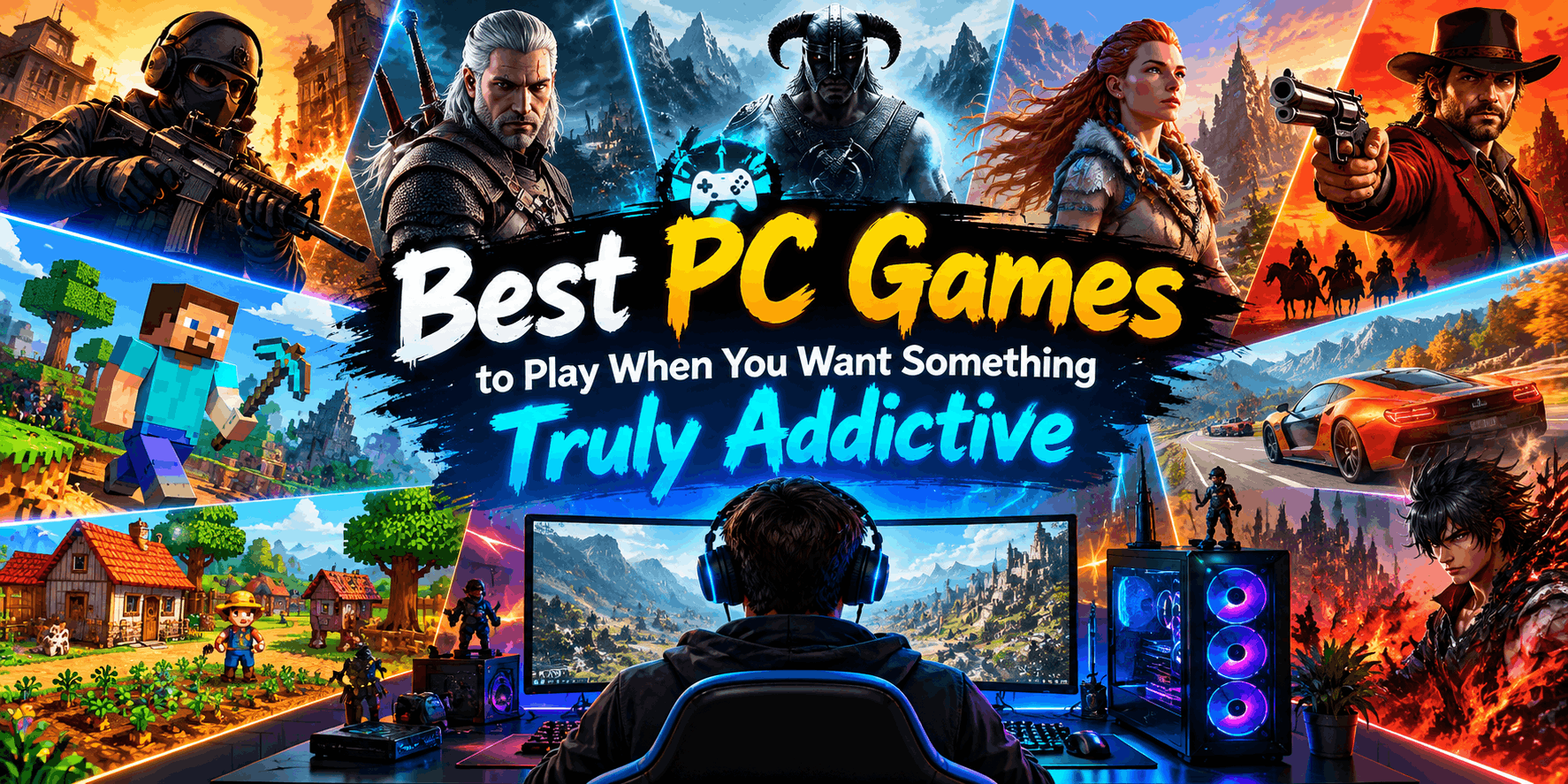
Finding a game that grabs your attention is easy. However, finding one that keeps you thinking about your next match, mission, build, or strategy after you have turned off your computer is much harder. The best PC games achieve exactly that by combining rewarding progression, challenging gameplay, meaningful choices, and enough variety to make every session feel different.
Moreover, PC gaming offers an enormous range of experiences. You can spend an evening surviving in an open world, compete against other players in a tactical shooter, build an entire civilization, or simply relax with a farming simulator. Consequently, there is no single formula for an engaging PC game.
Instead, the games with the strongest staying power usually give players something meaningful to pursue. That might be improving mechanical skill, discovering new locations, developing a character, collecting resources, competing on a leaderboard, or experimenting with new strategies.
So, if you are searching for PC games to play that can keep you entertained for dozens—or potentially hundreds—of hours, the following games and genres are excellent places to start.
What Makes a PC Games So Addictive?
In gaming, “addictive” is often casually used to describe a game that is exceptionally engaging and difficult to put down. However, a genuinely enjoyable game should still fit comfortably around your responsibilities and healthy gaming habits.
Generally, highly engaging PC games share several characteristics.
They provide clear objectives while continuously introducing new challenges. Furthermore, many offer progression systems that reward players with abilities, equipment, rankings, resources, or access to new areas.
Replayability is equally important. Randomized environments, competitive multiplayer, character customization, branching decisions, procedural generation, and player-created content can make two gaming sessions feel completely different.
Most importantly, great games create a satisfying gameplay loop:
Play → Learn → Progress → Unlock → Improve → Try Again
Because players can see themselves improving, completing “just one more mission” or playing “one more match” becomes extremely tempting.
1. Counter-Strike 2 Best PC Games
For players who enjoy competitive shooters, Counter-Strike 2 remains one of the most recognizable choices in PC gaming.
Instead of overwhelming players with complicated abilities, the game centers heavily on tactical positioning, accuracy, map knowledge, communication, economy management, and teamwork. Therefore, learning the basic objective is relatively straightforward, while mastering the game can take an enormous amount of time.
Valve describes Counter-Strike 2 as a Source 2-based evolution of Counter-Strike featuring Premier mode, CS Ratings, global and regional leaderboards, updated maps, dynamic smoke grenades, and redesigned audiovisual systems.
Furthermore, the competitive structure creates constant opportunities for improvement. A player can work on crosshair placement, recoil control, movement, grenade usage, communication, or strategic decision-making.
That depth helps explain its remarkable staying power. Steam’s live charts continue to place Counter-Strike 2 among the platform’s most-played games.
Best for: Competitive FPS fans, tactical players, and multiplayer gamers.
2. Minecraft PC Games
Few PC games offer as much freedom as Minecraft.
At first glance, the concept appears simple: explore a block-based world, gather materials, craft equipment, and build structures. Yet that simplicity quickly develops into an enormous sandbox filled with exploration and creativity.
In Survival mode, players collect resources, construct shelters, craft tools, explore environments, and deal with hostile creatures. Creative mode, meanwhile, removes many survival limitations and provides unlimited building resources.
As a result, different players can enjoy Minecraft in completely different ways.
Some build enormous cities. Others explore caves, automate resources, survive challenging worlds, experiment with redstone, play multiplayer servers, or create elaborate projects.
Additionally, Minecraft demonstrates an important principle behind highly replayable games: player-created goals can be more powerful than predefined objectives.
There is always another building to construct, biome to explore, system to improve, or idea to test.
Best for: Creative players, survival fans, builders, explorers, and casual multiplayer groups.
3. Dota 2
If strategic depth is what keeps you engaged, Dota 2 offers an exceptionally demanding competitive experience.
Matches revolve around two teams attempting to destroy the opposing team’s Ancient. However, beneath that straightforward objective lies an enormous amount of strategic decision-making.
Players must understand heroes, abilities, positioning, items, map awareness, team composition, timing, resource management, and opponent behavior.
Therefore, improvement is rarely limited to faster reactions. Instead, players continually develop better decision-making and game knowledge.
That enormous skill ceiling helps give Dota 2 remarkable longevity. In fact, it remains near the top of Steam’s official most-played rankings alongside Counter-Strike 2.
Nevertheless, beginners should expect a learning curve. Starting with tutorials, practicing a small hero pool, and learning one concept at a time can make the experience significantly more manageable.
Best for: Strategy-focused players, competitive gamers, and people who enjoy mastering complex systems.
4. Stardew Valley
Not every engaging PC game needs explosions, competitive rankings, or high-pressure combat.
Stardew Valley proves that progression can be just as compelling when the experience is relaxing.
Players gradually develop a farm while managing crops, resources, relationships, exploration, and other activities. Consequently, each in-game day presents numerous small decisions.
Should you improve the farm?
Explore?
Gather resources?
Complete another objective?
Interact with characters?
Because progress occurs incrementally, even a short gaming session can feel productive. Moreover, players have considerable freedom to decide what success means to them.
For that reason, Stardew Valley is particularly appealing to people who enjoy cozy games, simulation games, resource management, and long-term progression.
Best for: Relaxed gaming sessions, simulation fans, and progression-focused players.
5. Baldur’s Gate 3
Players searching for story-rich PC games should consider Baldur’s Gate 3.
Its appeal comes largely from player choice. Rather than simply following a rigid sequence of events, players make decisions that can influence relationships, encounters, quests, and how situations develop.
Furthermore, character building adds another layer of experimentation. Different classes, abilities, party combinations, dialogue choices, and combat approaches encourage players to think strategically.
Therefore, replay value comes not merely from repeating the same adventure but from wondering what might happen if you approach it differently.
A decision-driven RPG can be especially engaging because curiosity becomes part of the gameplay loop. Players want to know what is behind the next door, how a character will react, or whether another strategy would produce a different outcome.
Best for: RPG enthusiasts, story-focused gamers, and players who enjoy meaningful choices.
6. Terraria
Terraria combines exploration, crafting, combat, progression, building, and discovery in a way that constantly encourages players to investigate what comes next.
Initially, you may simply gather basic resources and create shelter. However, progression gradually introduces new equipment, enemies, environments, crafting possibilities, and challenges.
As a result, the game creates a strong sense of discovery.
You obtain better equipment so you can explore more dangerous areas. Then, those areas provide resources that help you craft stronger items. Subsequently, stronger equipment allows you to tackle even greater challenges.
This interconnected progression loop makes Terraria particularly effective for players who enjoy sandbox games but still want noticeable advancement.
Best for: Exploration, crafting, sandbox, survival, and progression fans.
7. Civilization VI
Sometimes the famous “one more turn” feeling is more powerful than “one more match.”
Civilization VI is built around long-term strategic decisions. Players develop a civilization while managing cities, technologies, resources, diplomacy, military power, culture, and expansion.
However, every decision creates consequences.
Expanding rapidly may provide more territory, yet it can introduce new management challenges. Focusing heavily on military strength might improve security, whereas investing elsewhere may accelerate another path toward success.
Therefore, the game constantly encourages planning.
Additionally, because civilizations, maps, opponents, and strategies vary, each campaign can develop differently. That unpredictability significantly increases replay value.
Best for: Turn-based strategy fans and players who enjoy long-term planning.
8. Hades
Hades is an excellent example of how repetition can remain entertaining when failure itself contributes to progress.
The game uses a roguelike structure in which individual escape attempts can play differently. Consequently, players learn enemy behavior, experiment with weapons and upgrades, and gradually improve their understanding of combat.
More importantly, unsuccessful attempts do not necessarily feel meaningless.
Instead, each run can provide knowledge, progression, story development, or opportunities to experiment.
That creates one of gaming’s strongest engagement loops: failure → learning → improvement → another attempt.
Therefore, Hades works particularly well for players who want fast-paced combat without committing to enormous multiplayer matches or open-world campaigns.
Best for: Action fans, roguelike players, and gamers who enjoy skill-based progression.
9. Balatro
Card-based games demonstrate that engaging gameplay does not require photorealistic graphics or enormous open worlds.
Balatro revolves around strategic card combinations and increasingly complex decisions. Because each run can develop differently, players continuously adapt rather than simply repeating an identical solution.
Moreover, successful runs encourage experimentation.
Perhaps one strategy works extremely well during one attempt. However, different available resources during the next run may force an entirely different approach.
That unpredictability keeps decision-making active and gives the game substantial replay potential.
Best for: Strategy players, card-game fans, and gamers looking for shorter repeatable sessions.
10. Valheim
For players who enjoy survival games, Valheim combines exploration, crafting, base building, combat, and cooperative play.
The world encourages preparation. Players gather materials, improve equipment, build bases, explore unfamiliar areas, and prepare for increasingly difficult encounters.
Consequently, progress feels connected.
Building is not simply decorative. Exploration is not merely sightseeing. Likewise, gathering resources contributes directly to survival and advancement.
Furthermore, playing cooperatively can dramatically change the experience because groups can divide responsibilities, explore together, construct larger settlements, and tackle difficult encounters as a team.
Valheim also continues to attract substantial activity on Steam; recent official charts have placed it among the platform’s highly played titles.
Best for: Survival fans, cooperative groups, explorers, and builders.
How Are PC Games Different From Mobile Games?
Both PC games and mobile games can provide excellent entertainment, although their design priorities often differ.
Mobile games generally emphasize accessibility and convenience because smartphones allow people to play almost anywhere. Consequently, many mobile experiences are designed around shorter sessions and touch controls.
PC gaming, meanwhile, can support keyboard-and-mouse controls, controllers, powerful hardware, complex interfaces, extensive customization, large-scale strategy, competitive esports, modding, and longer gaming sessions.
Nevertheless, the boundary between the platforms is becoming increasingly flexible. Some games appear across PCs, consoles, and mobile devices, allowing players to choose whichever platform fits their habits.
Therefore, the better platform depends less on which device is objectively superior and more on the experience you want.
Why Simple Games Like Dice Games Can Still Be Highly Engaging
Complexity is not required for replayability.
Traditional dice games, card games, puzzle games, and digital tabletop experiences can be compelling because uncertainty forces players to make decisions with incomplete information.
A dice roll introduces probability. However, the meaningful part is often what the player decides before and after that roll.
Should you take another risk?
you protect your current score?
Should you change strategy?
Consequently, strong dice games combine luck with risk management and decision-making. This is similar to the principle used by many roguelikes and strategy games: uncertain outcomes create fresh situations that players must adapt to.
Therefore, whether someone prefers a massive PC RPG or a lightweight digital dice game, replayability frequently comes from meaningful decisions rather than graphical complexity.
What About Sports Fans Searching for Houston Texans Games?
The word “games” can also have a completely different search intent.
Someone searching for Houston Texans games, for example, is usually looking for NFL schedules, results, broadcasts, tickets, or football-related information rather than PC gaming recommendations.
Understanding that distinction is important when searching online. If you want video games, queries such as “best PC games,” “multiplayer PC games,” “PC sports games,” or “football games for PC” will generally produce more relevant results than a broad sports-team query.
Finding the Right PC Game for Your Preferences
Instead of choosing a game simply because it is popular, start with the experience you actually enjoy.
If competition motivates you, consider Counter-Strike 2 or Dota 2. Conversely, if creativity matters more, Minecraft may be a better fit. Players who enjoy narrative choices can explore Baldur’s Gate 3, while people interested in relaxing progression may prefer Stardew Valley.
Meanwhile, Terraria and Valheim suit players who enjoy crafting and exploration. Civilization VI appeals to long-term strategic thinkers, whereas Hades and Balatro are strong choices for repeatable runs and experimentation.
Before purchasing or installing any game, also consider your available time, preferred multiplayer or single-player experience, PC specifications, difficulty preference, and whether you want short sessions or lengthy campaigns.
Ultimately, popularity can tell you what many people are playing, but it cannot determine what you will personally enjoy.
Frequently Asked Questions On PC Games
Minecraft is one approachable option because players can choose how they want to engage with the game. Creative mode provides unlimited resources and removes many survival restrictions, while Survival mode introduces resource gathering, crafting, exploration, and enemies.
Neither platform is universally better. PC games often provide deeper control options, more demanding graphics, modding, and complex gameplay systems, whereas mobile games emphasize portability and convenience. Your preferred gaming style should determine which platform suits you.
Yes. A game being free does not automatically mean it offers less depth. Counter-Strike 2, for example, is free-to-play on Steam and includes competitive systems such as Premier mode and CS Ratings. Always check monetization, system requirements, and community feedback before investing significant time in any free-to-play title.
Sandbox, competitive, simulation, survival, and strategy games often support very long playtimes because their gameplay is not dependent on completing one fixed story. Minecraft, Dota 2, Counter-Strike 2, Civilization VI, Terraria, and Valheim are examples of games designed around repeatable systems and long-term mastery.
Replayable PC games commonly use competitive ranking, progression systems, procedural generation, strategic choices, multiplayer interactions, character builds, crafting, exploration, user-generated content, or multiple approaches to the same objective.
Strong options include Counter-Strike 2, Minecraft, Dota 2, Stardew Valley, Baldur’s Gate 3, Terraria, Civilization VI, Hades, Balatro, and Valheim. However, the best choice depends on whether you prefer competitive multiplayer, RPGs, strategy, survival, simulation, or shorter repeatable runs.
Final Thoughts On PC Games
The best PC games are not necessarily the newest, biggest, or most visually impressive. Instead, the games that keep players returning usually provide meaningful choices, satisfying progression, opportunities to improve, and enough variety to prevent every session from feeling identical.
Competitive players may spend countless sessions refining their skills in Counter-Strike 2 or Dota 2. – For creative players, Minecraft offers endless possibilities to build, explore, and create unique experiences. Strategy fans can lose themselves in Civilization VI, while RPG enthusiasts may become absorbed in the choices and characters of Baldur’s Gate 3.
At the same time, games such as Hades, Terraria, Valheim, Stardew Valley, and Balatro demonstrate how completely different genres can achieve the same goal: making the player genuinely curious about what happens next.
Ultimately, that curiosity is what makes a great PC game difficult to put down. Whether you prefer competitive multiplayer, open-world exploration, survival, strategy, RPGs, dice games, or experiences inspired by the quick accessibility of mobile games, the right game is the one that continually gives you another meaningful challenge to explore.




One thought on “The Ultimate List of Best PC Games”