


Finding safe kid games that combine exciting gameplay, educational value, and family entertainment can be challenging. Children want adventures, rewards, and memorable challenges, while parents want age-appropriate content, manageable screen time, and protection from unwanted online interactions.
Fortunately, gaming offers plenty of choices. From creative building adventures and superhero missions to strategic dice games and brain-teasing puzzles, different games can encourage problem-solving, imagination, and friendly competition.
This guide explores 15 entertaining gaming options, explains what makes each one enjoyable, and highlights important safety considerations. Whether your family prefers online multiplayer games, educational activities, or classic tabletop challenges, you’ll find practical ideas for your next gaming session.
15 Best Safe Kid Games Worth Exploring
1. Schnyder’s Dice of Fire – Competitive Dice Games and Strategic Challenges, Safe Kid Games
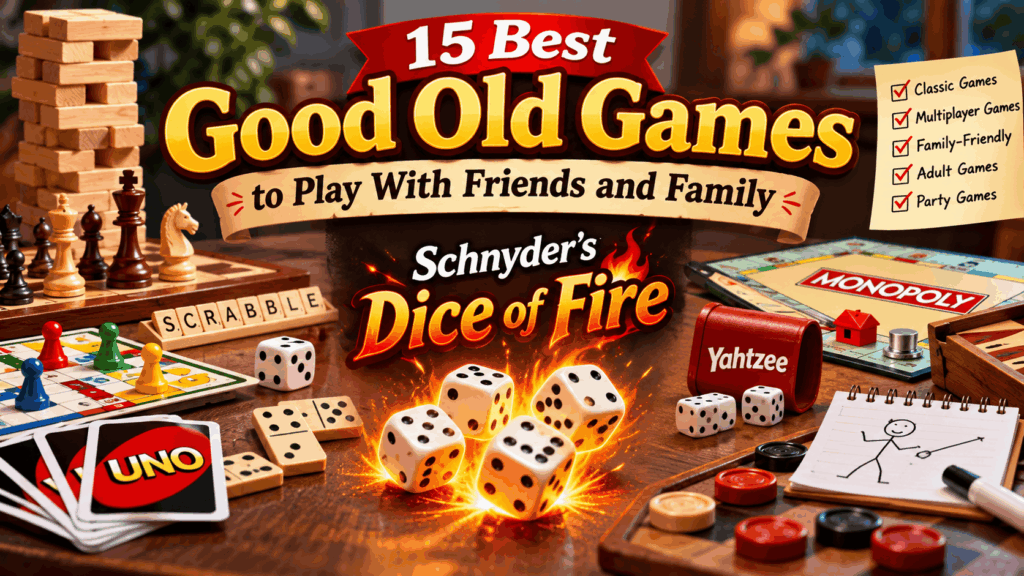
For families interested in competitive dice games, Schnyder’s Dice of Fire introduces an exciting combination of luck, strategic decisions, and calculated risks.
Players compete to reach 10,000 points. However, they must first score and bank 1,000 points in a single turn to enter the competition. This creates interesting decisions: should players secure their current score or continue rolling for a potentially higher reward?
The game features two-player and four-player competition, making it appealing to people who enjoy tactical multiplayer experiences.
Gaming benefits: Mental arithmetic, probability discussions, decision-making, and friendly competition.
Safety consideration: Its suitability for children has not been independently established. Parents should verify the current age rating, advertisements, purchases, privacy practices, and multiplayer features before allowing children to play. Treat it as a supervised option only when appropriate.
2. Minecraft (Creative Mode) – Safe Kid Games
Minecraft Creative Mode transforms an open world into a giant construction playground. Players can build castles, design villages, and experiment with imaginative structures without focusing on survival challenges.
Additionally, collaborative building can encourage planning and communication.
Best for: Creative exploration and cooperative projects. Parents should use private worlds, review multiplayer permissions, and check the edition’s age rating.
3. Coolmath Games – Puzzles That Make Thinking Fun
Cool Math Games offers browser-based activities involving logic, timing, strategy, and problem-solving.
Games such as Run 3 and Fireboy and Watergirl challenge players to navigate obstacles and plan their moves. Despite its name, not every game teaches mathematics directly.
Best for: Puzzle enthusiasts and short thinking challenges. Parents should review individual games, advertisements, and external links.
4. Chess – The Ultimate Strategy Challenge
Chess turns every move into a decision. Players must protect their king, anticipate their opponent’s plans, and recognize tactical opportunities.
For beginners, short chess puzzles and simplified matches make learning easier. Meanwhile, family tournaments can encourage patience and thoughtful competition.
Best for: Strategy, concentration, and planning. Offline chess avoids public chat and online interactions entirely.
5. LEGO City Undercover – Imaginative Adventures
LEGO City Undercover combines exploration, humorous storytelling, and puzzle-solving in a colorful environment.
Players investigate missions, discover hidden objects, and experiment with different character abilities.
Best for: Children who enjoy adventures and exploration. Check the specific LEGO game’s rating because content varies across the franchise.
6. Marvel’s Spider-Man 2 and Other Spider-Man Games – Superhero Action
Spider-Man games bring web-swinging, spectacular movement, and superhero storytelling to life.
However, not every Spider-Man title is suitable for young children. Some feature intense combat, mature themes, and stronger violence.
Best for: Older players who meet the individual game’s age rating. Parents should review gameplay before purchasing.
7. Mario Kart 8 Deluxe – Family Racing Fun
Mario Kart combines colorful racing tracks, surprising power-ups, and competitive multiplayer action.
Because races are relatively short, families can organize tournaments without committing to lengthy sessions.
Best for: Local family competition and coordination. Review online communication settings and optional online subscriptions.
8. Animal Crossing: New Horizons – Relaxing Island Adventures
Animal Crossing invites players to decorate homes, collect items, fish, and develop their own virtual island.
Its slower pace provides an alternative to action-heavy games. Furthermore, customization encourages imagination and personal expression.
Best for: Relaxed creative gameplay. Parents should supervise online island visits and interactions.
9. Pokémon Scarlet and Violet – Exploration and Tactical Battles
Pokémon games combine creature collecting, exploration, and turn-based challenges.
Players consider different strengths, weaknesses, and abilities when building their teams. Consequently, battles offer opportunities to practice planning and decision-making.
Best for: Adventure and accessible strategy. Review the specific title’s rating and online features.
10. Toca Boca World – Creative Storytelling
Toca Boca World lets children invent characters, decorate environments, and create imaginative everyday stories.
Rather than emphasizing competition, the experience encourages open-ended role-play.
Best for: Imaginative play. Parents should check optional purchases and device permissions.
11. PBS KIDS Games – Educational Entertainment
PBS KIDS Games includes activities inspired by familiar educational characters.
Children can explore counting, reading, patterns, and other foundational concepts through interactive challenges.
Best for: Younger learners and educational play. Adults should select activities that match the child’s developmental stage.
12. Monument Valley – Beautiful Visual Puzzles
Monument Valley challenges players to navigate imaginative structures using perspective, rotation, and optical illusions.
Instead of relying on speed, its puzzles reward observation and experimentation.
Best for: Spatial reasoning and thoughtful puzzle-solving. Check the specific edition’s rating and purchase requirements.
13. Just Dance – Active Family Entertainment
Just Dance turns popular music into movement-based challenges.
Players follow choreography, improve their scores, and compete or cooperate during family dance sessions.
Best for: Active entertainment and coordination. Review song lyrics, online features, and available space before playing.
14. UNO – Classic Family Card Competition
UNO is easy to learn but full of unpredictable moments.
Players match colors or numbers, use action cards, and adapt their strategies as the game progresses.
Best for: Turn-taking, number recognition, and social interaction. The physical card version avoids digital advertisements and online communication.
15. Sudoku – Brain-Teasing Number Challenges
Sudoku asks players to complete number grids using logical elimination.
Beginner-friendly 4×4 puzzles provide an accessible introduction, while larger grids offer progressively greater challenges.
Best for: Logical reasoning, attention, and persistence. Printable puzzles are a useful screen-free alternative.
How to Choose Safe Kid Games for Your Family
An entertaining game is not automatically a child-safe game. Before choosing, parents should consider several important factors:
- Age ratings: Check ESRB, PEGI, or local classifications for the specific title.
- Online communication: Disable or restrict public chat and interactions with strangers.
- Advertisements and purchases: Review monetization, subscriptions, and purchase restrictions.
- Privacy: Understand what information the game collects and whether accounts are necessary.
- Screen-time balance: Encourage breaks and combine gaming with physical activities.
Most importantly, try the game together. A short shared session often reveals more about its suitability than promotional descriptions alone.
FAQ On Safe Kid Games
Parents can improve online gaming safety by checking age ratings, limiting public communication, disabling unauthorized purchases, reviewing privacy settings, and playing alongside their children. Additionally, discussing online behavior and encouraging children to report uncomfortable interactions helps establish healthier gaming habits.
Not necessarily. Spider-Man games differ significantly in combat intensity, themes, and age classifications. Some titles are intended for teenagers rather than young children. Therefore, parents should check each game’s official rating, content descriptors, and gameplay footage before deciding.
Both can offer engaging problem-solving activities. Cool Math Games features various logic and timing challenges, while chess introduces strategic planning and tactical thinking. Parents should select age-appropriate difficulty levels and supervise websites with advertising or interactive features.
Dice games can provide opportunities to practice counting, addition, probability, and decision-making. For example, comparing possible scores encourages children to consider different outcomes. However, educational benefits depend on the game’s rules, the child’s age, and how adults support the experience.
Schnyder’s Dice of Fire offers competitive dice gameplay centered on scoring, risk management, and reaching 10,000 points. However, its child suitability cannot be confirmed without reliable age-rating and safety information. Parents should review advertising, purchases, multiplayer interactions, and privacy before considering supervised play.
PBS KIDS Games, age-appropriate chess activities, Minecraft Creative Mode, and beginner Sudoku are useful options. Each offers different experiences, from foundational learning to imaginative building and logical challenges. However, parents should verify ratings, account settings, and individual game content.
Conclusion On Safe Kid Games
The best safe kid games balance enjoyment, age-appropriate content, and meaningful opportunities for creativity or learning. While Minecraft encourages imaginative construction, chess develops strategic play, and Mario Kart delivers memorable family competition, every gaming experience requires thoughtful selection.
Parents should prioritize verified age suitability, review online features, and participate whenever possible. Whether your family enjoys dice games, superhero adventures, or screen-free puzzles, choosing games around children’s interests and maturity can turn ordinary playtime into an enjoyable shared experience.





One thought on “15 Best Safe Kid Games for Fun, Learning, and Family Entertainment”