



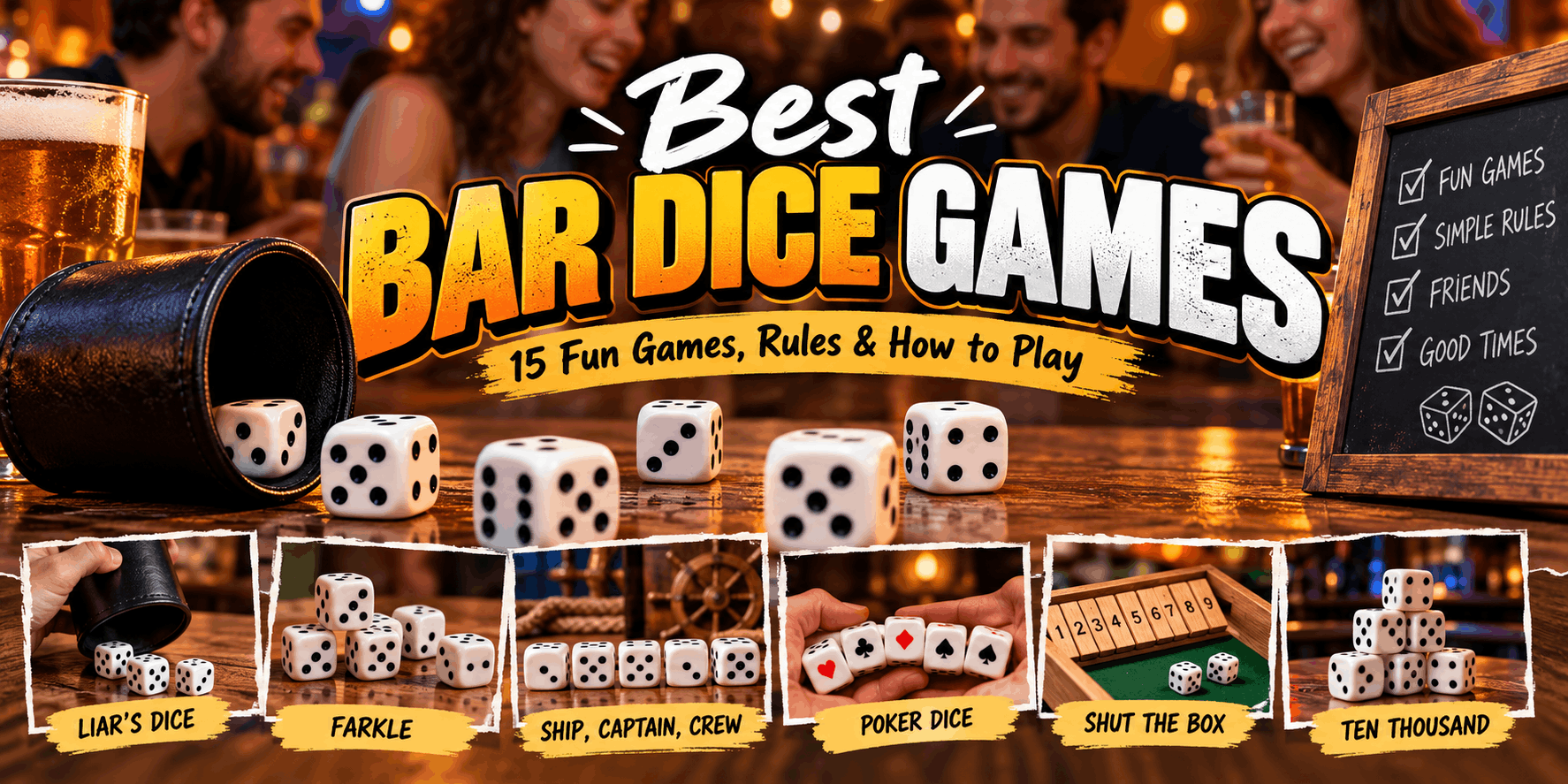
There is something uniquely satisfying about hearing dice rattle inside a cup, hit the table, and reveal a result that can completely change the game. That simple moment explains why Bar Dice Games have remained such entertaining social games. You do not need an expensive gaming setup, a complicated board, or an hour-long tutorial. Instead, in many cases, all you need is a handful of six-sided dice, a table, a few players, and an understanding of the rules.
More importantly, bar dice games aren’t all based on pure luck. Although every roll introduces randomness, many games add bluffing, probability, risk management, scoring decisions, or push-your-luck mechanics. Consequently, two games played with the same ordinary dice can feel completely different.
Whether you’re looking for a quick pub game, a party dice game, something to play during game night, or simply a new tabletop challenge, this guide covers 15 of the best bar dice games, including their basic rules and how to play.
What Are Bar Dice Games?
Bar dice games are social tabletop games played primarily with dice, usually featuring quick rounds, simple rules, and competitive or push-your-luck gameplay. Traditional bar dice commonly uses five six-sided dice and a cup, although the exact equipment and rules vary considerably between games and regions.
In fact, one traditional form simply called Bar Dice revolves around building the strongest matching hand from five dice. Aces can function as wild dice in some rule sets, while regional variations may change how many rolls players receive or how hands are ranked.
However, the broader category includes everything from bluffing games such as Liar’s Dice to score-chasing games such as Farkle.
Therefore, the appeal is variety.
Some games can be learned in two minutes. Others reward players who understand probability. Meanwhile, games such as Liar’s Dice turn a few ordinary dice into a psychological battle.
Quick Comparison of the Best Bar Dice Games
| Bar Dice Game | Dice Needed | Main Gameplay | Best For |
|---|---|---|---|
| Bar Dice | 5 | Build matching hands | Traditional pub play |
| Ship, Captain, Crew | 5 | Sequence + scoring | Fast rounds |
| Liar’s Dice | 5 per player | Bluffing + deduction | Strategy groups |
| Farkle | 6 | Push your luck | Longer sessions |
| Mexico | 2 | Ranked combinations | Quick competition |
| Chicago | 2 | Target rolling | Beginners |
| Three Man | 2 | Social rule-based play | Parties |
| Pig | 1 | Risk vs. reward | Simple gameplay |
| Bunco | 3 | Target-number scoring | Larger groups |
| Sevens | 2 | Number combinations | Quick rounds |
| Beat That! | 2+ | Number building | Casual groups |
| Poker Dice | 5 | Poker-style combinations | Card-game fans |
| Going to Boston | 3 | Highest-score challenge | Beginners |
| Shut the Box | 2 | Dice + number strategy | Tactical players |
| Ten Thousand | 6 | Combination scoring | Competitive groups |
Now, let’s roll into the games themselves.
1. Traditional Bar Dice
If you’re specifically searching for Bar Dice Games, it makes sense to begin with the game commonly known simply as Bar Dice.
Typically, players roll five dice and attempt to create the strongest matching combination. In a common version, a valid hand contains at least one Ace, while Aces act as wilds that can join another number. Therefore, a player isn’t simply chasing the largest face values; the number of matching dice matters first.
How to Play
Roll five dice using a cup. After checking your result, keep useful dice and reroll according to your table’s agreed rules.
Then compare final hands.
Generally, having more matching dice beats having fewer. For example, four matching dice beat three matching dice regardless of their face values under common rules.
Why play it? It is fast, competitive, and extremely easy to replay.
However, traditional Bar Dice has many local variations. Therefore, agree on wild-Ace rules, hand rankings, and the number of rolls before starting.
2. Ship, Captain, Crew
Few bar dice games capture the excitement of chasing a specific sequence as effectively as Ship, Captain, Crew.
You need five standard dice. Your first objective is to secure:
- 6 = Ship
- 5 = Captain
- 4 = Crew
However, there is a catch: they must be collected in that order.
Once you have your 6, 5, and 4, the remaining two dice become your “cargo.” Their combined total determines your score. Players normally receive up to three rolls to complete the sequence and maximize their cargo.
For example, suppose you finish with:
6, 5, 4, 6, 3
Your cargo equals 9.
Because two cargo dice can total a maximum of 12, you’re always hoping to finish with double sixes.
Best for: Players who want something quick, easy, and suspenseful.
3. Liar’s Dice
Want something with considerably more psychology?
Play Liar’s Dice.
Rather than showing everyone your roll, each player normally rolls dice beneath a cup and secretly checks their own result. Players then make increasingly high bids about how many dice of a particular face they believe exist across the entire table.
For example:
“There are four 5s.”
The next player can raise the bid or challenge it.
If someone calls the bluff, the dice are revealed and the claim is checked. Consequently, good players aren’t simply lucky—they understand probability and, more importantly, know how to read their opponents.
Common versions start players with five dice, although exact bidding and wildcard rules can vary.
Best for: Bluffers, strategic thinkers, and competitive groups.
4. Schnyder’s Dice of Fire
Schnyder’s Dice of Fire is a fast-paced multiplayer dice game that combines strategy, risk, and luck in every roll. Players must make smart decisions about when to keep rolling and when to bank their points, because pushing your luck too far can quickly change the game.
Players need to reach 1,000 points to get on the board, while the race toward 10,000 points keeps every round competitive. Special gameplay elements, including the Red Die, Must-Bust situations, and last-chance opportunities, add extra tension and strategy.
Designed for players who enjoy social and competitive dice games, Schnyder’s Dice of Fire brings the excitement of classic bar-style dice games into a modern digital multiplayer experience.
Whether you’re looking for a multiplayer dice game, strategy dice game, fun dice game for adults, or a modern bar-style dice game, Schnyder’s Dice of Fire gives every roll a reason to think twice.
Roll smart. Bank big. Risk everything.
5. Mexico
Mexico proves that two dice are enough to create a tense competitive game.
Players roll two dice, after which the higher die is normally read first. Thus:
- 6 + 5 becomes 65
- 5 + 3 becomes 53
- 4 + 2 becomes 42
However, doubles outrank ordinary combinations.
Most importantly, 2-1 is “Mexico” and beats everything, including 6-6, in a common rule set.
That unexpected ranking makes the game much more entertaining than simply rolling for the largest total.
Furthermore, the opening player can determine the number of throws available in some versions, which introduces another layer of decision-making.
Best for: Fast head-to-head or small-group competition.
6. Chicago
Not every great dice game needs complicated scoring.
Chicago, sometimes called Rotation, is played across 11 rounds, with target totals progressing from 2 through 12.
During the first round, you’re trying to roll 2.
Next, you need 3.
Then 4.
Eventually, the final target becomes 12.
One traditional scoring approach awards points equal to the target number when you hit it. Therefore, rolling the required 8 during the appropriate round earns eight points.
Since two dice produce 7 more frequently than extreme totals such as 2 or 12, the middle rounds naturally feel different from the edge rounds.
Best for: Beginners, families, and casual game nights.
7. Three Man
Three Man is one of the more chaotic social dice games.
First, one player becomes the “Three Man.” Afterward, players take turns rolling two dice, with different results triggering different actions.
Common variations associate results involving 3 with the Three Man, while totals such as 7, 10, or 11 and doubles can trigger additional rules. However, Three Man has developed numerous house-rule variations, so groups should establish their rule sheet before playing.
Although traditionally associated with drinking-game culture, the mechanics can easily be adapted into a points, tokens, or challenge-based party game.
Best for: Groups that enjoy unpredictable social games.
8. Pig
Pig is beautifully simple.
On your turn, roll one die repeatedly and accumulate points.
You have two choices:
Hold: Bank your points and end your turn.
Roll again: Risk your current turn total for another chance to score.
However, roll a 1 and your unbanked turn points disappear.
Therefore, Pig introduces one of gaming’s oldest and most addictive decisions: How much risk is too much?
Because the rules are so straightforward, Pig can also work well as one of the simpler kids dice games when played purely for points.
Best for: Beginners and players learning push-your-luck mechanics.
9. Bunco
Bunco is especially useful when you have a bigger group.
Typically played with three dice, the game revolves around rolling a target number that changes from round to round. For instance, players seek ones during one round, twos during another, and so forth.
Because turns move quickly, Bunco creates a lively atmosphere without requiring complicated tactical decisions.
Additionally, the repetitive target system makes the rules accessible even when several people are learning simultaneously.
Best for: Parties and larger gaming groups.
10. Sevens
If you want a quick two-dice challenge, try Sevens.
The exact rules vary, but many games built around seven use the probability of two-dice totals as the central mechanic. Since there are more combinations capable of producing seven than any other total with two standard six-sided dice, games centered on seven can create fast, frequent action.
For a simple house version, assign points for rolling 7 while giving bonus or penalty conditions to neighboring totals such as 6 and 8.
Consequently, you get an easy game that can be customized without requiring additional equipment.
Best for: Quick casual rounds.
11. Beat That!
Beat That! looks incredibly simple until someone makes the wrong decision.
Players roll two or more dice and arrange the results into the largest possible number.
For instance, suppose you roll:
2 and 6
You can create either 26 or 62.
Naturally, 62 is better.
However, add more dice, rerolls, or restrictions and the decisions become more interesting.
Because it combines number recognition with gaming, it can also be adapted into kids dice games without losing its competitive appeal.
Best for: Families, beginners, and quick tabletop sessions.
12. Poker Dice
Love poker but don’t have a deck nearby?
Poker Dice translates familiar hand-building concepts into dice gameplay.
Players roll five dice and attempt to form combinations such as:
- Pair
- Three of a kind
- Full house
- Four of a kind
- Five of a kind
Depending on the chosen rule set, straights and other combinations may also count.
The interesting part is deciding which dice to keep and which to reroll. Consequently, every turn feels like a miniature hand-management puzzle.
Furthermore, Poker Dice provides a natural bridge for people who already enjoy card and dice games online, because it combines recognizable poker-style hand rankings with dice mechanics.
Best for: Poker fans and players who enjoy combination-building games.
13. Going to Boston
Going to Boston is easy to explain and surprisingly competitive.
Players generally start with three dice.
First, roll all three and keep the highest die.
Then roll the remaining two and keep the highest again.
Finally, roll the last die.
Add the three kept results together to create your final score.
After everyone completes a turn, the highest total wins the round.
Although luck plays a major role, each reveal builds suspense because your score develops one die at a time.
Best for: Players who want virtually zero setup.
14. Shut the Box
Shut the Box combines dice rolling with number-selection strategy.
Traditionally, players roll two dice and use the total to close numbered tiles. Depending on the rules, a total such as 8 might let you close:
- 8
- 5 + 3
- 6 + 2
- 4 + 3 + 1
As more numbers disappear, your options become increasingly limited.
Therefore, unlike pure luck-based bar games, Shut the Box makes you think about which number combinations should remain available for later turns.
If you enjoy outdoor entertainment, the concept also scales nicely into oversized yard dice games or giant tabletop setups.
Best for: Players who want luck mixed with number strategy.
15. Ten Thousand
Finally, if your group wants a longer scoring battle, try Ten Thousand.
The game belongs to the same broad push-your-luck family as Farkle. Players roll multiple dice, collect scoring combinations, and decide whether to bank their points or continue rolling.
The objective, as the name suggests, is commonly to reach a target around 10,000 points, although house rules can alter the exact winning condition and scoring table.
As a result, Ten Thousand works particularly well when your group wants more than a two-minute bar challenge.
Every turn creates the same delicious dilemma:
Bank what you have—or roll again and chase something bigger?
Best for: Longer competitive sessions.
How to Choose the Right Bar Dice Game
With so many options, the “best” game depends on your group.
If everyone is new to dice games, start with Pig, Chicago, Going to Boston, or Ship, Captain, Crew. Their rules can be explained quickly, which means players spend more time rolling and less time reading instructions.
On the other hand, if your group enjoys strategy and deception, choose Liar’s Dice. Because hidden information drives the game, experienced players can use probability and behavioral clues rather than relying solely on lucky rolls.
Meanwhile, Farkle and Ten Thousand are excellent for players who love risk-versus-reward decisions.
For poker fans, Poker Dice offers familiar hand-building mechanics.
Finally, if you’re playing with children, non-drinking versions of Pig, Beat That!, Chicago, and Going to Boston can work as accessible kids dice games.
What Makes Bar Dice Games So Fun?
Their biggest advantage is their simplicity.
Most Bar Dice Games require very little equipment. Therefore, players can start almost anywhere—a kitchen table, game room, backyard table, pub, campsite, or party.
Furthermore, dice naturally create suspense.
Unlike a complicated strategy game where an experienced player may know they’re winning long before the game ends, a single roll can suddenly reverse a dice game.
At the same time, not every game is completely random.
Liar’s Dice adds bluffing.
Farkle adds risk management.
Shut the Box adds number strategy.
Poker Dice adds hand building.
Ship, Captain, Crew adds sequencing and reroll decisions.
Consequently, changing the rules can completely transform the experience even though you’re still rolling the same six-sided cubes.
Taking Dice Games Beyond the Bar
Despite the name, you don’t actually need a bar to enjoy bar-style dice games.
For example, giant wooden or foam dice can turn familiar mechanics into yard dice games for BBQs, outdoor parties, picnics, and family gatherings.
Likewise, digital versions have made dice mechanics accessible to people searching for card and dice games online, multiplayer dice games, virtual tabletop games, and browser-based dice games.
The setting changes, but the appeal remains the same: roll, react, calculate your options, and hope the next throw goes your way.
Tips for a Better Dice Game Night
First, agree on the rules before starting. Traditional dice games often have regional and household variations. Therefore, deciding how wild dice, ties, rerolls, penalties, and scoring work prevents arguments later.
Second, keep rounds moving. One reason bar dice games work so well socially is their speed.
Third, use a visible score sheet for games such as Chicago, Farkle, or Ten Thousand. Otherwise, players can easily lose track as scores grow.
Additionally, match the complexity to the group. Beginners will probably enjoy Ship, Captain, Crew faster than a complicated Liar’s Dice variation.
Finally, remember that stakes aren’t necessary. Points, chips, tokens, or simple bragging rights work perfectly well.
Frequently Asked Questions About Bar Dice Games
No. Traditional Bar Dice and Ship, Captain, Crew commonly use five, while games such as Chicago and Mexico use two. Farkle commonly uses six. Therefore, the required number depends entirely on the game.
Absolutely. Standard dice work fine on a suitable surface, while oversized dice can transform many simple games into yard dice games for outdoor parties, BBQs, camping trips, and family gatherings.
Yes, provided the game is separated from drinking or gambling mechanics. Games such as Schnyders die of fire, Chicago, Beat That!, and Going to Boston can be adapted into family-friendly kids dice games using points or tokens.
Ship, Captain, Crew, sometimes associated with the name 6-5-4, requires players to secure a 6 (Ship), 5 (Captain), and 4 (Crew) in order. Afterward, the remaining two dice become the player’s cargo score.
Liar’s Dice is one of the strongest choices for strategic players because it combines probability, hidden information, bidding, bluffing, and opponent reading.
Schnyders die of fire, Pig, and Ship, Captain, Crew are among the easiest options. Ship, Captain, Crew, for example, revolves around rolling a 6, then 5, then 4 before scoring the remaining two dice as cargo.
Some of the most entertaining choices include Traditional Bar Dice, Ship, Schnyders die of fire, Crew, Liar’s Dice, Farkle, Mexico, Chicago, Three Man, Pig, Poker Dice, Shut the Box, and Ten Thousand. The best choice depends on whether your group prefers luck, bluffing, strategy, or push-your-luck gameplay.
Final Roll: Which Bar Dice Game Should You Play First?
The best Bar Dice Games succeed because they turn an incredibly simple object into a social experience.
If you want a classic pub-style challenge, start with Traditional Bar Dice. you want fast action, roll Ship, Captain, Crew.
If you enjoy bluffing and reading your opponents, Liar’s Dice should be near the top of your list.
Meanwhile, players who constantly think, “Just one more roll,” will probably love Farkle or Ten Thousand.
And that’s really the beauty of dice gaming. You can have two dice, five dice, or six dice sitting on the same table, yet a simple change in the rules creates an entirely different game.
So grab the dice, establish the house rules, gather a few players, and start rolling.
Because sometimes the best game night doesn’t need a screen, an elaborate board, or hundreds of pieces.
Sometimes, all it takes is one great roll.







One thought on “Best Bar Dice Games: 15 Fun Games, Rules & How to Play”